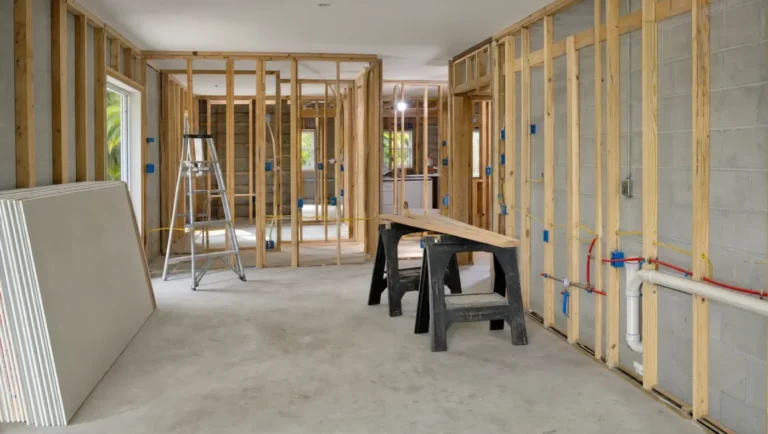
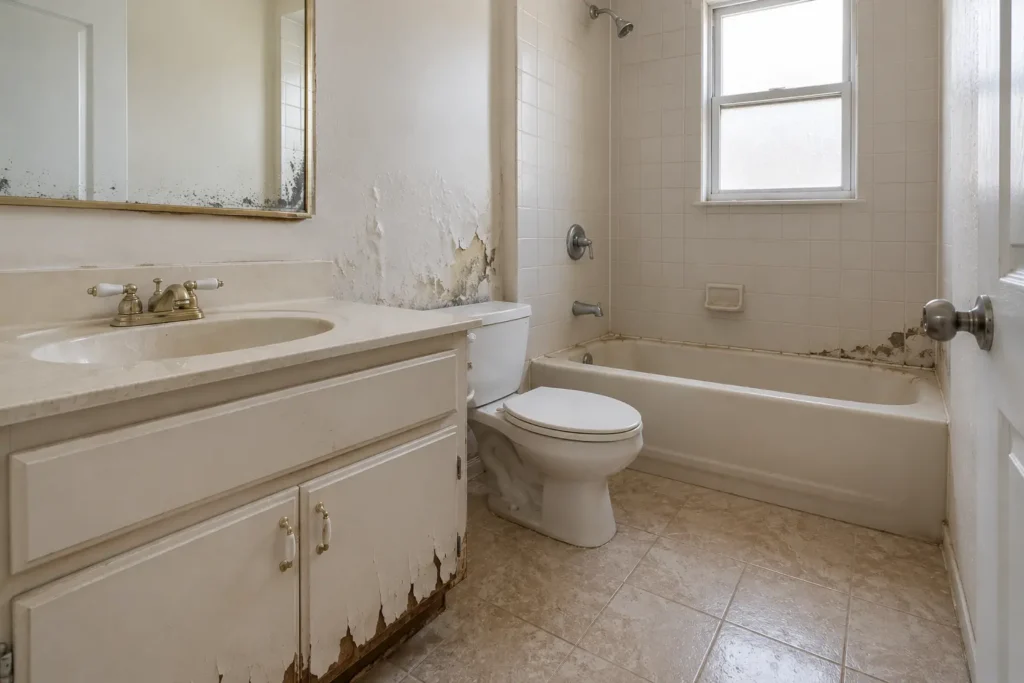
Florida bathrooms are exposed to some of the toughest moisture conditions in the country. Swollen vanity doors that no longer close. Black mold creeping through grout lines. Drywall softening behind tile you installed three years ago. A shower pan leak quietly destroying your subfloor for months before you notice the stain on the ceiling below.
These are not design problems. They are material and waterproofing failures. They happen because someone used the wrong products or skipped critical steps during installation. With outdoor humidity often exceeding 74 percent in the Tampa Bay and Sarasota areas [1], and the EPA recommending indoor levels stay between 30 and 50 percent to prevent mold [2], your bathroom faces constant moisture pressure every single day.
After thousands of bathroom remodels across Tampa Bay, the failures we see most often are not from tile choice alone. They come from missing waterproofing, poor ventilation, and low-grade cabinetry that was never built for this climate. Choosing the best bathroom materials for Florida humidity is not about aesthetics first. It is about selecting products that will not degrade, combined with installation methods that keep water where it belongs. This guide breaks down exactly what works, what fails, and why the installation matters as much as the material itself.
Why Florida Bathrooms Fail
Most bathroom failures in Florida trace back to three causes: porous materials absorbing ambient moisture, inadequate waterproofing behind finished surfaces, or improper ventilation trapping steam inside the room.
The science is straightforward. Florida’s subtropical climate produces dew points in the low-to-mid 70s throughout summer [1]. Your HVAC system fights to keep indoor humidity below the EPA’s recommended 50 percent ceiling [2], but every hot shower temporarily overwhelms that effort. Steam condenses on cooler surfaces, and if those surfaces are porous or if the waterproofing behind them is incomplete, water migrates into the wall cavity. Once it is there, you will not see it until the damage is significant.
Material selection for a Tampa bathroom remodeling project or a Sarasota bathroom remodel cannot be treated as a purely cosmetic decision. The wrong choice does not just look bad over time. It fails structurally, grows mold, and forces you to pay for the same renovation twice.
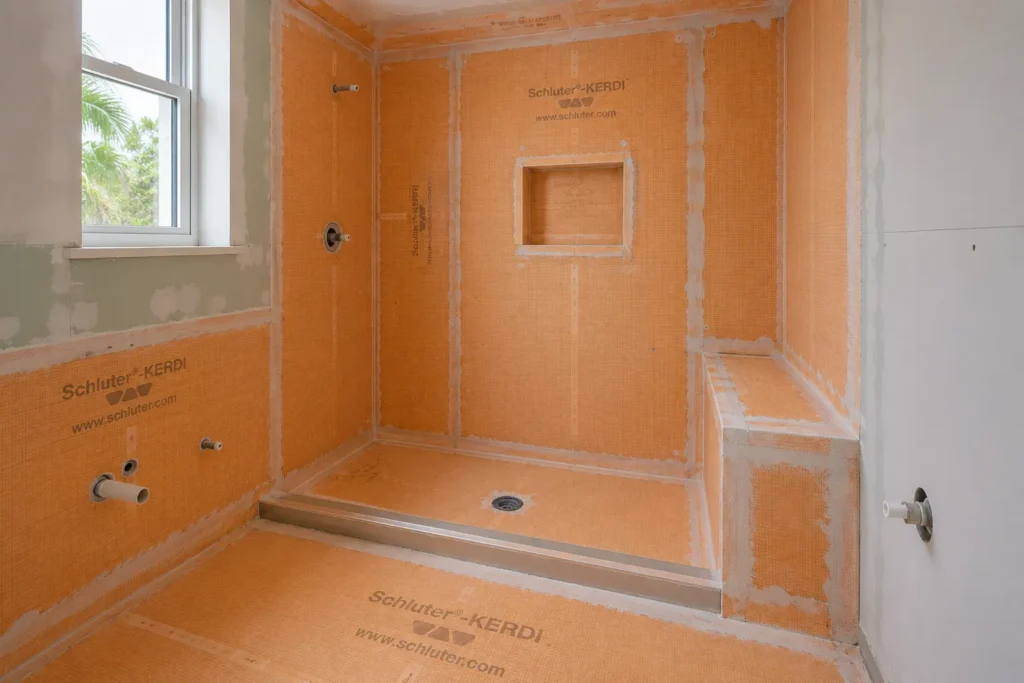
Waterproofing: The Layer You Never See
If there is one section of this article that matters more than the rest, it is this one. The waterproofing layer behind your tile is the single most important component in a Florida bathroom. It is also the component most often done incorrectly or skipped entirely by contractors cutting corners.
We use the Schluter waterproofing system behind every project because it is the most reliable method for preventing failures in high-humidity environments. The system centers on KERDI, a pliable, sheet-applied polyethylene membrane functioning as both a waterproofing barrier and vapor retarder [3]. Unlike traditional approaches relying on cement backer board (which is water-resistant but not waterproof), the Schluter system creates a sealed envelope around the entire wet area.
| Component | What It Does | Why It Matters in Florida |
| Schluter KERDI Membrane | Provides a continuous waterproof and vapor-retardant barrier | Stops both liquid water and vapor from reaching the wall cavity, eliminating hidden mold risk |
| Schluter KERDI-BOARD | Structural substrate and waterproofing panel in one | Replaces cement board entirely, reducing weight and installation complexity |
| KERDI-BAND and Sealed Seams | Waterproofs all joints, corners, and pipe penetrations | Prevents the most common failure point: water escaping through seams |
The difference between a shower that lasts five years and one that lasts twenty-five years almost always comes down to what is behind the tile. This is also where licensing matters. Proper waterproofing installation requires understanding how plumbing penetrations, drain connections, and structural substrates interact. Our team holds a state-certified plumbing contractor license (CFC 1430533) in addition to our general contractor license (CGC 1516665), which means the same company responsible for the waterproofing membrane is also responsible for the plumbing connections that penetrate it. No finger-pointing between trades. One team, one accountability. This single-point accountability is why we rarely see the callback issues that plague projects where waterproofing and plumbing are handled by separate parties.
Not sure if your current bathroom has proper waterproofing? Many homeowners discover the problem only after visible damage appears. Request a free in-home consultation and we will assess your current conditions before recommending a scope of work.
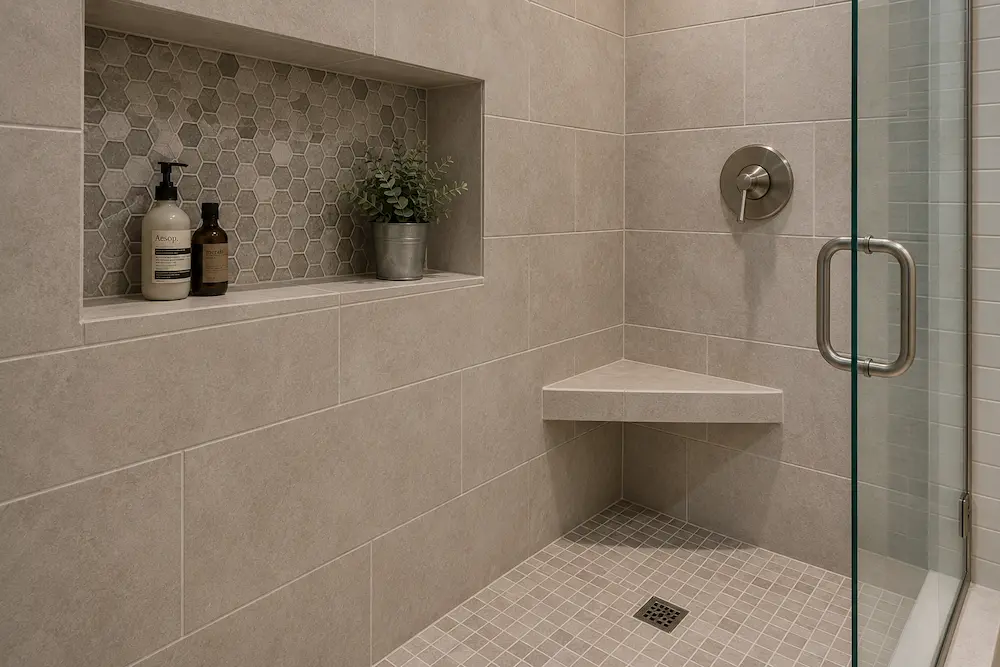
Tile and Grout: Choosing What Survives
Once the waterproofing envelope is sealed, the surface materials serve as the first line of defense against daily moisture exposure.
Porcelain Tile
Porcelain is the gold standard for Florida bathroom floors and walls. Manufactured at extremely high temperatures, it produces a tile so dense that it absorbs 0.5 percent or less of its weight in water, the threshold defined by ANSI A137.1 standards [4]. That near-zero absorption rate means porcelain will not swell, crack, or harbor mold regardless of how humid your Clearwater bathroom remodel environment becomes.
We work extensively with Emser Tile and Happy Floors. Both offer porcelain collections specifically engineered for wet environments. Their large-format options (12×24 and larger) reduce grout lines, creating fewer potential weak points in the finished surface. For homeowners loving the look of natural wood or stone, both manufacturers produce wood-look and marble-look porcelain delivering the aesthetic without the maintenance liability.
Grout Selection
Tile is only as durable as the grout between it. Traditional cement-based grout is porous. It absorbs water, stains, and eventually becomes a breeding ground for mold. In wet areas, we specify epoxy grout. It is non-porous, stain-resistant, and does not require sealing. It costs more upfront but eliminates the ongoing maintenance cycle that cement grout demands in a humid climate.
Frameless Glass Enclosures
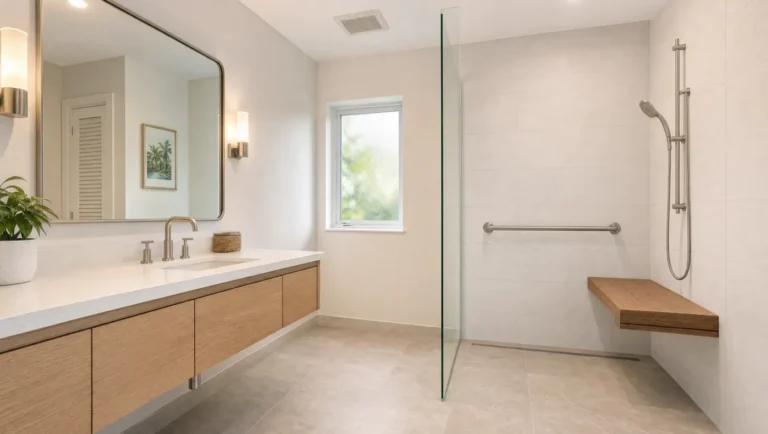
For shower enclosures, frameless glass is both a design upgrade and a moisture-management advantage. Traditional framed shower doors trap water in the metal channels, creating hidden areas where mold thrives. Frameless glass eliminates those channels entirely, allowing water to shed cleanly and making the enclosure far easier to maintain. The tempered glass required by the Florida Building Code for wet-area applications also provides superior safety compared to standard glass panels.
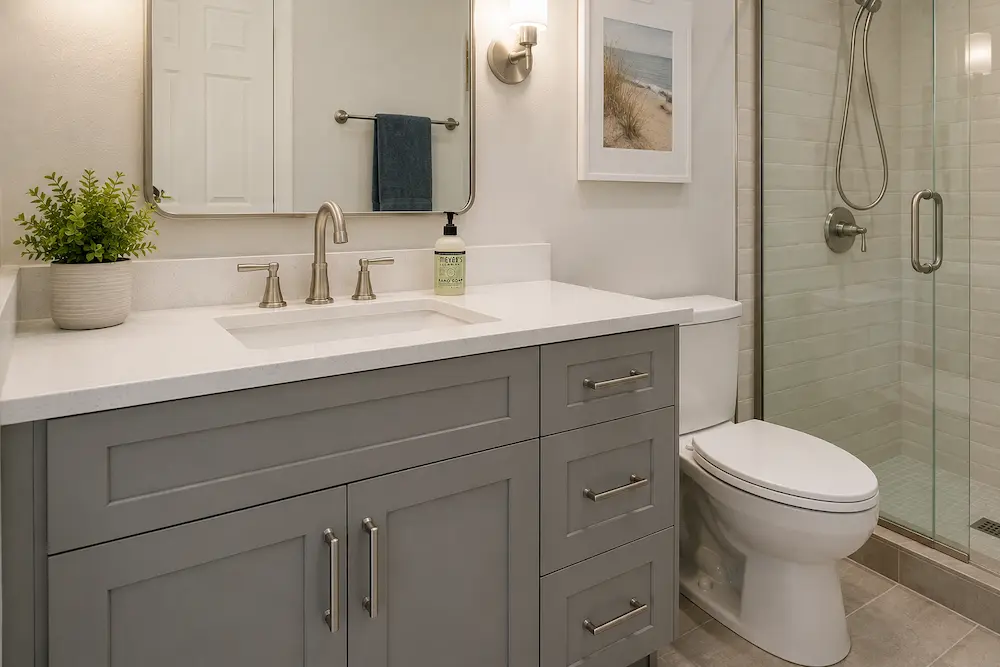
Cabinetry, Countertops, and Fixtures
Cabinetry
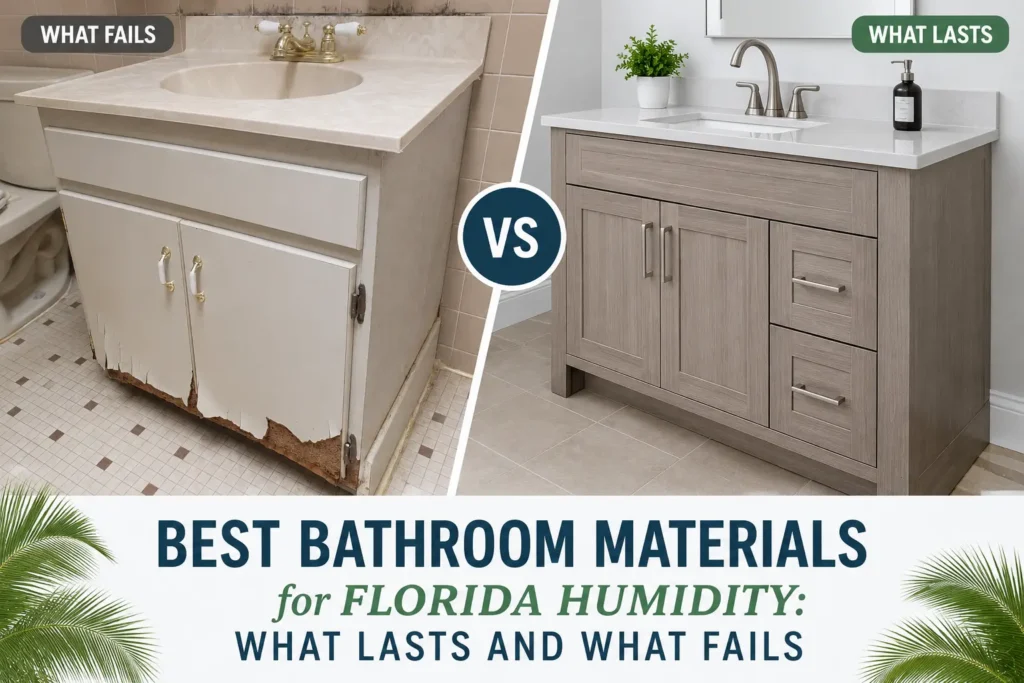
The vanity is typically the first casualty of humidity damage in a Florida bathroom. Particleboard construction, standard in builder-grade and big-box-store vanities, absorbs ambient moisture through every exposed edge. Within two to three years, you see swelling, delamination, and soft spots.
We specify Fabuwood cabinetry for bathroom vanities because their construction uses furniture-grade plywood rather than particleboard. Plywood is dimensionally stable under humidity fluctuations, meaning the doors will still close properly five and ten years from now. The finish quality also matters. A properly sealed, multi-coat finish prevents moisture from penetrating the wood surface in the first place.
Countertops
Engineered quartz is the clear winner for bathroom countertops in humid environments. Natural stones like granite and marble are porous and require regular sealing to prevent water absorption and staining. Miss a sealing cycle, and you risk permanent damage. Quartz is non-porous by manufacturing, requires zero sealing, and resists both moisture and bacterial growth. It delivers the premium appearance of natural stone without the maintenance vulnerability.
Fixtures and Hardware
Fixture quality matters more in humid climates because inferior finishes corrode faster. We install Delta and Moen fixtures, both of which offer lifetime warranties and use corrosion-resistant finishes engineered for high-moisture environments. Cheap, unbranded fixtures from overseas manufacturers often develop pitting, discoloration, and internal valve failures within a few years of Florida humidity exposure. The fixture is the component you touch every day; it should not be the place you cut your budget.
Ventilation and Moisture Control
Even the best materials cannot overcome a ventilation system failing to remove moisture from the room. Proper ventilation is not optional for a St. Petersburg bathroom remodeling project or any bathroom in our service area. It is a code requirement and a material-preservation necessity.
The Florida Building Code requires ventilation in all bathrooms, either through an operable window meeting minimum size requirements or through a mechanical exhaust system (FBC Residential R303.3). In practice, a window alone is not enough for our climate. Most Florida homeowners keep windows closed because the AC is running, which means that window provides zero ventilation for the majority of the day. We strongly recommend mechanical ventilation on every project regardless of whether a window exists. Exhaust fans must be properly sized for the room’s square footage and must vent directly to the exterior of the home. Venting into an attic or soffit, which we see frequently in older homes, simply relocates the moisture problem and often leads to roof deck rot or attic mold.
For optimal performance, the fan should be rated for continuous operation and connected to a humidity-sensing switch or timer that keeps it running for 15 to 20 minutes after the shower ends. This ensures the room returns to safe humidity levels before moisture has time to settle on surfaces and penetrate grout lines.
Because ventilation involves both electrical work (fan wiring, switch installation) and sometimes structural modifications (duct routing through walls or ceilings), it requires a contractor with the appropriate licenses. Our registered electrical contractor license (ER 13016498) means our team handles the complete ventilation installation in-house rather than subcontracting it to a third party who may not understand how it integrates with the waterproofing and finish work.
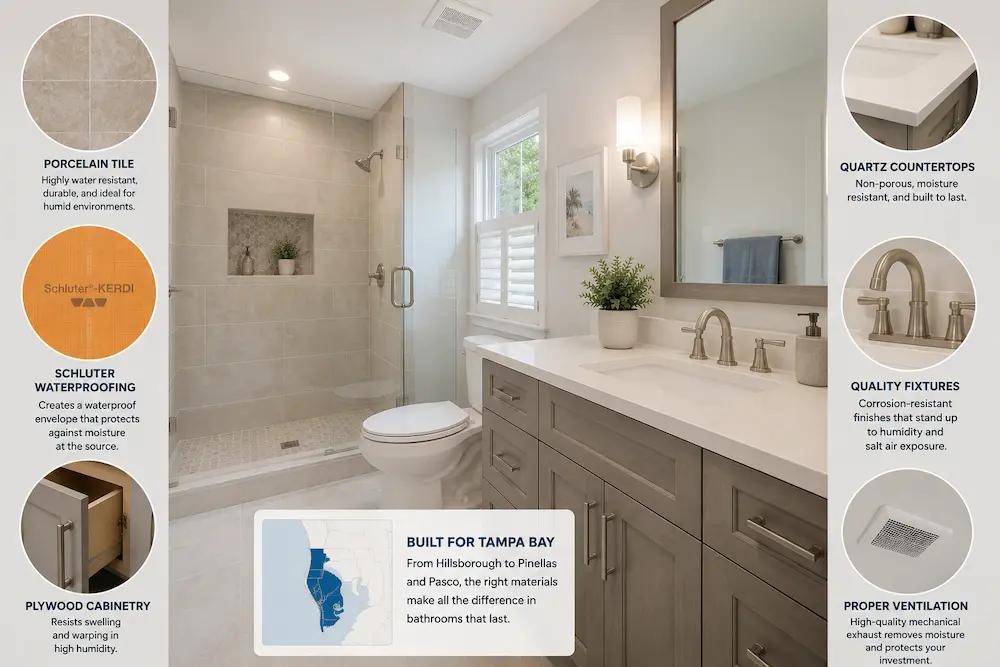
Best Bathroom Materials for Tampa Bay Homes
Every county in our service area presents the same core challenge: relentless humidity combined with salt air exposure near the coast. Whether you are planning a bathroom renovation in Hillsborough County, updating a guest bath in Pinellas, or gutting a master bathroom in a Pasco ranch home, the material requirements are identical. Porcelain tile, Schluter waterproofing, plywood-construction cabinetry, quartz countertops, and properly vented mechanical exhaust are non-negotiable for long-term performance.
Homeowners in Sarasota and Manatee counties face the same conditions. Coastal properties in Clearwater, Dunedin, and Palm Harbor add salt air corrosion to the equation, making fixture quality and finish durability even more critical. Inland communities like Lakewood Ranch, Wesley Chapel, and Land O’ Lakes deal with slightly less salt exposure but identical humidity levels.
We serve all of these areas from our Tampa headquarters. Every project receives the same material standards, the same Schluter waterproofing system, and the same licensed team regardless of location. The climate does not change at the county line, and neither do our specifications.
Common Mistakes That Lead to Paying Twice
- Using standard drywall in wet areas. Paper-faced drywall absorbs water on contact. Even “moisture-resistant” green board is not waterproof. If it is behind your shower tile without a proper membrane system, it is only a matter of time before it fails.
- Skipping waterproofing because the tile “looks sealed.” Tile and grout are not waterproof. They are water-resistant at best. Without a dedicated membrane system behind them, water migrates through grout joints and into the wall cavity.
- Installing particleboard vanities. They cost less upfront and fail faster. In Florida’s humidity, particleboard absorbs moisture through every unfinished edge, including the underside and interior surfaces that never get sealed.
- Relying on a window instead of mechanical ventilation. A window provides passive airflow when open. It provides nothing when closed, which is most of the time your AC is running. While the code allows a window as an alternative, mechanical ventilation is the only reliable method for removing shower steam in Florida’s climate.
- Hiring a contractor without plumbing and electrical licenses. Waterproofing failures almost always occur at plumbing penetrations. If the company installing your waterproofing membrane is not the same company responsible for the plumbing connections that pass through it, accountability gaps are inevitable.
Permits and Inspections: Your Safety Net
Permits protect the homeowner by requiring inspections and code-compliant work at every critical stage. When a bathroom remodel is permitted, an independent inspector verifies that the waterproofing, plumbing, electrical, and structural components meet the Florida Building Code before they are concealed behind finished surfaces.
Without a permit, no one verifies the work. If the waterproofing was installed incorrectly, if the electrical is not up to code, or if the plumbing connections are substandard, you will not know until something fails. At that point, the cost to repair is typically two to three times the cost of doing it correctly the first time.
The Florida Building Code also requires tempered glass for any window located in a wet area such as a shower enclosure. This is a safety requirement that an inspector will verify during a permitted project but that an unpermitted contractor may ignore entirely.
CMK Construction manages a high volume of remodeling permits across Hillsborough, Pinellas, Pasco, Sarasota, and Manatee counties. We coordinate all inspections so that you never have to wonder whether the work behind your walls was done correctly.
Frequently Asked Questions
1. What is the best flooring for a humid bathroom in Florida?
Porcelain tile is the best choice for bathroom flooring in Florida’s humid climate. Because it is fired at extremely high temperatures during manufacturing, porcelain achieves a density that limits water absorption to 0.5 percent or less of its weight. In practical terms, this means the tile will not swell, warp, crack, or harbor mold even after years of exposure to Florida’s humidity levels. Laminate and hardwood floors, by contrast, absorb moisture through their edges and seams, leading to buckling and structural failure in high-humidity environments. If you prefer the look of wood, wood-look porcelain tile from manufacturers like Emser and Happy Floors delivers the aesthetic without any of the moisture vulnerability.
2. Do I really need an exhaust fan if my bathroom has a window?
While the Florida Building Code technically allows natural ventilation through an operable window as an alternative to a mechanical exhaust system, a window alone is not adequate for Florida’s climate. Most homeowners keep windows closed because their air conditioning is running, which means the window provides zero ventilation for the majority of the day. An exhaust fan actively pulls moisture-laden air out of the bathroom and vents it to the exterior of the home, which is the only reliable way to reduce post-shower humidity to safe levels. Without mechanical ventilation, steam settles on every surface in the room, accelerates grout deterioration, and creates conditions where mold can establish itself within 24 to 48 hours. We install mechanical ventilation on every bathroom project regardless of whether a window is present.
3. Why does CMK use the Schluter system instead of traditional cement board?
Traditional cement backer board is water-resistant, meaning it will not disintegrate when wet, but it is not waterproof. Moisture in vapor form can still pass through the board and reach the wall studs behind it, where it condenses and creates ideal conditions for mold growth and wood rot. The Schluter KERDI membrane is a true waterproofing barrier and vapor retarder that stops both liquid water and vapor completely. When installed as a system with sealed seams, corners, and pipe penetrations, it creates a continuous envelope that guarantees no moisture reaches the wall cavity. We use this system behind every project because it is the most reliable method for preventing the hidden failures that are so common in Florida’s climate.
4. Can I use real wood floors in a Florida bathroom?
Installing solid hardwood in a Florida bathroom is strongly discouraged. Wood is hygroscopic, meaning it absorbs and releases moisture in response to humidity changes. In a bathroom environment where humidity spikes with every shower and ambient levels remain high year-round, hardwood will expand, contract, cup, and eventually rot. Engineered hardwood performs slightly better but still carries significant risk in wet areas. The safest alternative is wood-look porcelain tile, which is completely impervious to moisture while delivering a remarkably realistic wood grain appearance. Several of our tile partners, including Happy Floors, offer wood-look collections with long plank formats that are virtually indistinguishable from real hardwood once installed.
5. How long does a bathroom remodel take?
A standard bathroom renovation typically takes between four and eight weeks from demolition to final walkthrough. Custom bathroom renovations involving extensive plumbing relocation, structural modifications, or specialized materials such as large-format tile or custom frameless glass enclosures may require additional time. The timeline depends heavily on material lead times and inspection scheduling, which is why working with a contractor who manages permitting and maintains relationships with local inspectors helps prevent unnecessary delays. Your dedicated project manager coordinates all of these moving parts so the project stays on schedule.