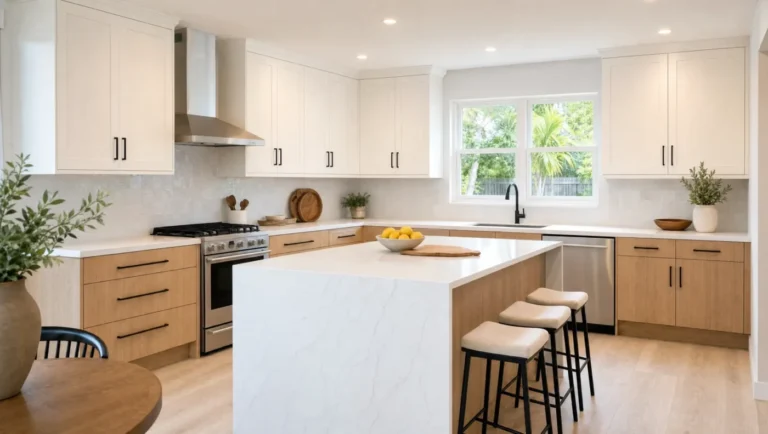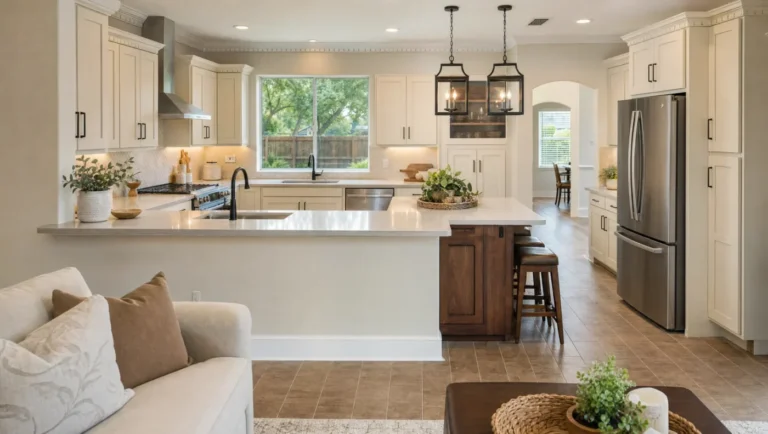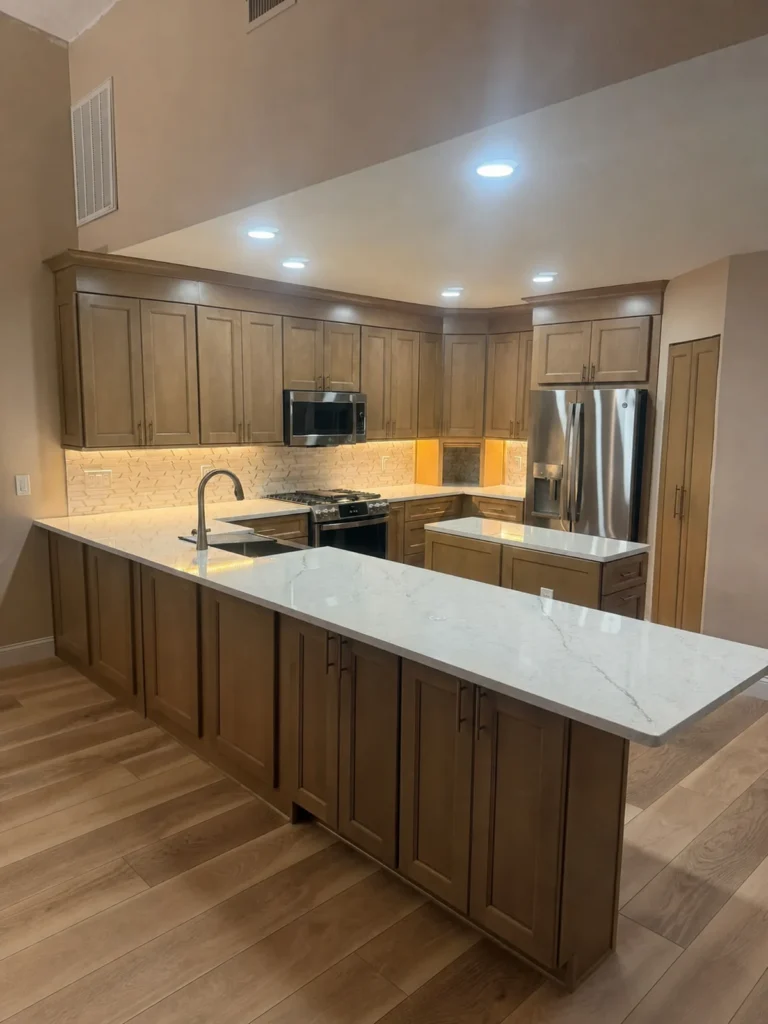
Green is the color our clients keep asking about, and it has earned the attention. It reads as calm in bright Florida light, it plays well with white quartz and warm wood, and it gives a kitchen personality without locking you into a look that feels dated in five years. The kitchens in this guide come from real CMK Construction projects, not stock photography, so you can see how sage green, olive, and dark forest cabinets actually look in homes like yours.
Reviewed by the CMK Construction team. CMK is a state certified general contractor, license CGC 1516665, and a state certified plumbing contractor, license CFC 1430533, serving Tampa Bay since 2004.
Quick Answer: Which Green Works Best
Sage green is the safest whole kitchen green for most Tampa Bay homes because it holds its color in strong natural light and pairs with almost any countertop. Dark greens like forest and hunter do their best work on an island or on lower cabinets under a white or warm white perimeter, where the contrast feels intentional instead of heavy. Brass and champagne bronze hardware warm a green kitchen up, matte black sharpens it, and for cost planning most Tampa Bay cabinet replacements land between $150 and $500 per linear foot installed, with full custom work running above that.
| Green family | Where it works best | Natural light needed | How it lives day to day |
|---|---|---|---|
| Sage | Whole kitchens, perimeters, islands | Works in almost any light | Hides dust and fingerprints better than white |
| Gray green | Coastal palettes, homes near the water | Low to moderate | Reads as a neutral, very forgiving |
| Olive | Warm, wood heavy rooms and older homes | Moderate | Forgiving, deepens nicely in evening light |
| Forest and hunter | Big open kitchens, islands, lower cabinets | Strong natural light | Shows smudges near hardware sooner, like any dark color |
What Green Kitchen Cabinets Cost
Green does not carry a color tax by itself. You are paying for the cabinet construction, the door style, and the finish quality, and the color rides along. The one place green moves the number is the finish route, since factory painted finishes cost more than basic stains, and that upgrade is worth it because a factory applied catalyzed finish handles Florida humidity and daily wear far better than a site painted job. For planning, most Tampa Bay cabinet replacements land between $150 and $500 per linear foot installed, while full custom cabinetry, specialty finishes, and layout changes can run well past that, and every number here is a planning range, not a quote. The full breakdown of stock, semi custom, and custom, and what moves a project up or down that range, lives in our guide to the cost to replace kitchen cabinets, and our kitchen cabinets page covers the lines and door styles we install.
Already picturing green in your kitchen? Call CMK Construction at (813) 379 2116 or request a free in home consultation and we will bring the conversation to your actual kitchen and your actual light.
Sage Green Kitchen Cabinets
Sage is the entry point for most homeowners, and for good reason. It is a gray softened green that behaves almost like a neutral, so it works with the tile, flooring, and countertops you already own. Most of the sage kitchens we build use shaker door styles, which keep the color feeling clean and current. If you want the case for that door style, read why shaker cabinets are still the smartest kitchen remodel choice in 2026.
1. Sage Green Perimeter With Brass Hardware
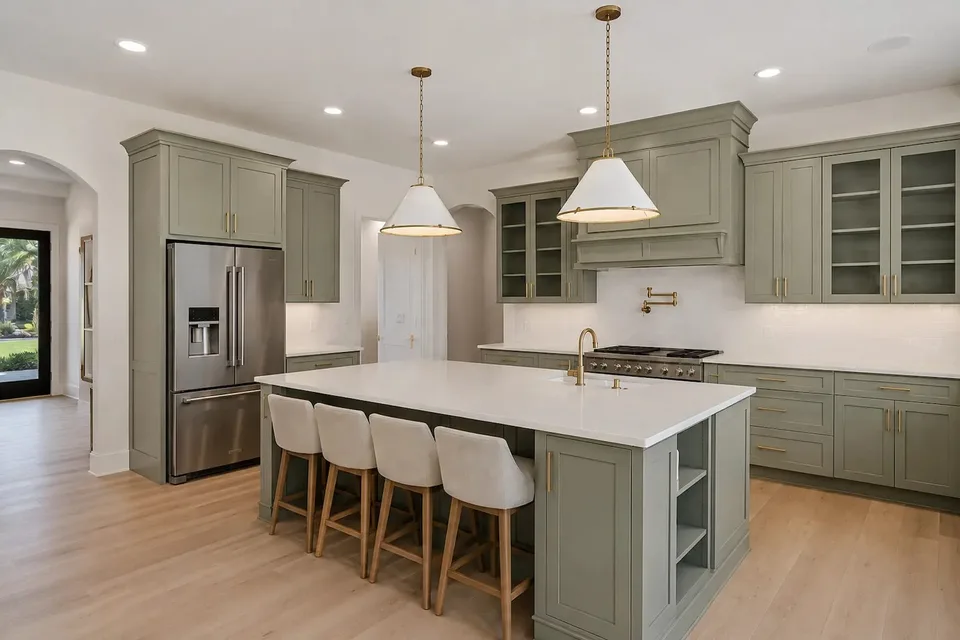
Sage on every cabinet, floor to ceiling. This Tampa kitchen runs the color across glass front uppers, a paneled range hood, and the island base, then lets white quartz and a simple white backsplash calm it all down. Brass shows up exactly where it should, in the slim pulls, the pot filler, and the pendant stems, so the green reads warm instead of gray even under recessed lighting. It photographs soft but lives practical, because sage hides fingerprints and dust better than white cabinets ever will.
2. Sage Green Island Under a White Perimeter
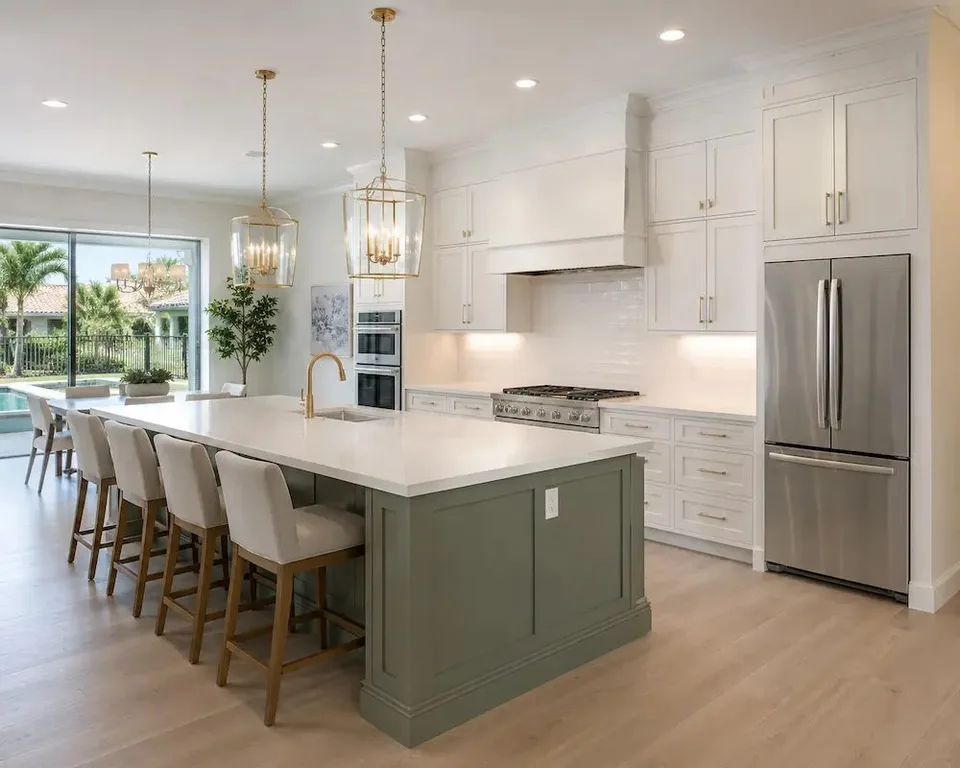
If a full sage kitchen feels like a commitment, put the color on the island and keep the perimeter white. This Sarasota project runs a long sage base with furniture style paneling under white quartz, seats five, and points the whole room at the pool through the sliders. Brass lantern pendants and gold hardware tie the island back to the white perimeter, and because the island is a contained piece, the color can be refinished years from now without touching another cabinet in the room.
3. Light Sage With Butcher Block and White Oak
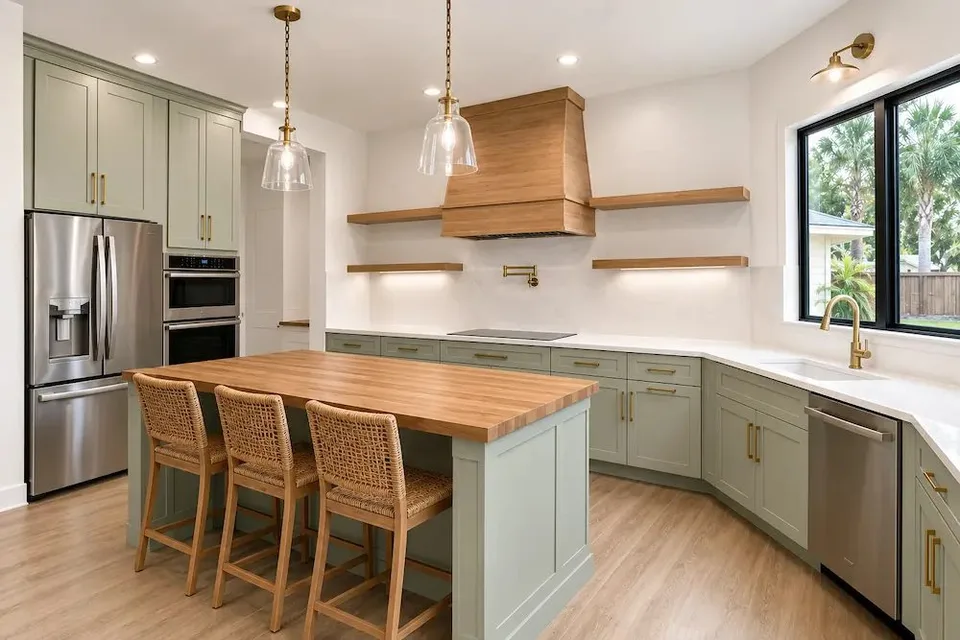
The lightest greens come alive next to natural wood, and this Palm Harbor kitchen proves it three ways, with a butcher block island top, a white oak range hood, and lit floating shelves flanking it. The sage is soft enough to act as the neutral while the wood carries all the warmth. With palms outside the black framed window and brass at the faucet and sconce, the room stays bright without the glare a pure white kitchen can throw.
Dark Green Kitchen Cabinets
Dark green is the confident choice, and in the right room it outperforms navy. It carries the same depth and formality but feels more natural, more connected to the landscaping outside your windows. If deep color is your direction, it is worth comparing this section against our blue kitchen ideas before you commit, because the two colors solve the same design problem in different moods.
4. Forest Green Shaker, Floor to Ceiling
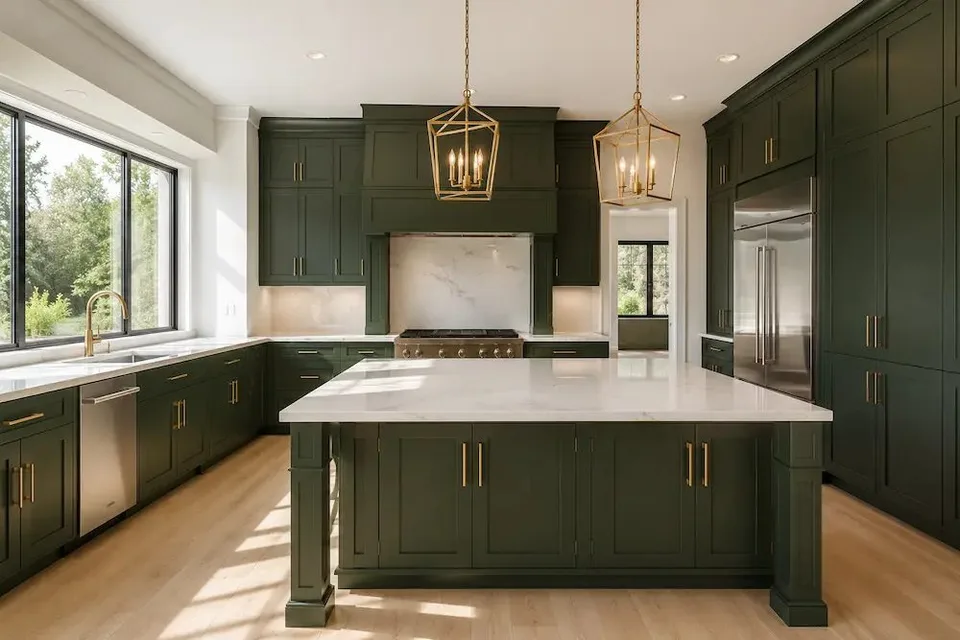
A full forest green kitchen only works when the room has the light to feed it, and this South Tampa project has it, with a wall of black framed glass pouring daylight onto floor to ceiling green, from the paneled hood to the tall pantry run that wraps the refrigerator. The marble look slab behind the range and the pale stone island top give the eye two bright resting points, and a pair of brass lantern pendants carries the warmth through the middle of the room. When the light is there, nothing else in this guide matches it.
5. Dark Green Island With a White Quartz Waterfall
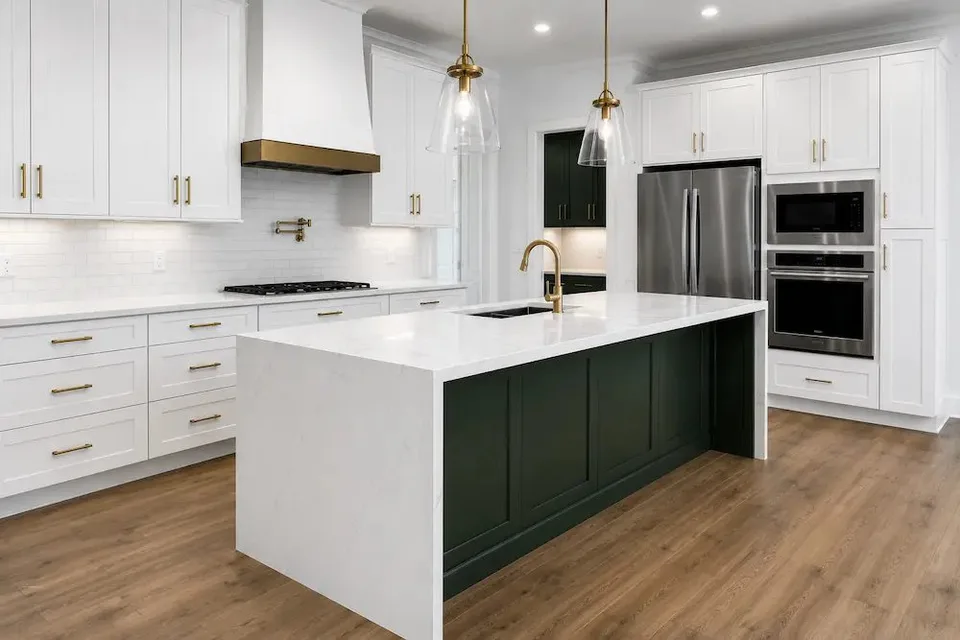
Wrap a white quartz waterfall over a dark green island and you get the highest contrast moment a kitchen can deliver. This Largo project drops the stone straight to the floor on the ends, framing a deep hunter green base inside an otherwise white kitchen, then repeats the green on a tall cabinet across the room so the island does not feel like a one off. Brass at the faucet, the pendants, and the hood band ties it together, and the combination stays legible from across the open living space.
6. Deep Green With Matte Black Hardware

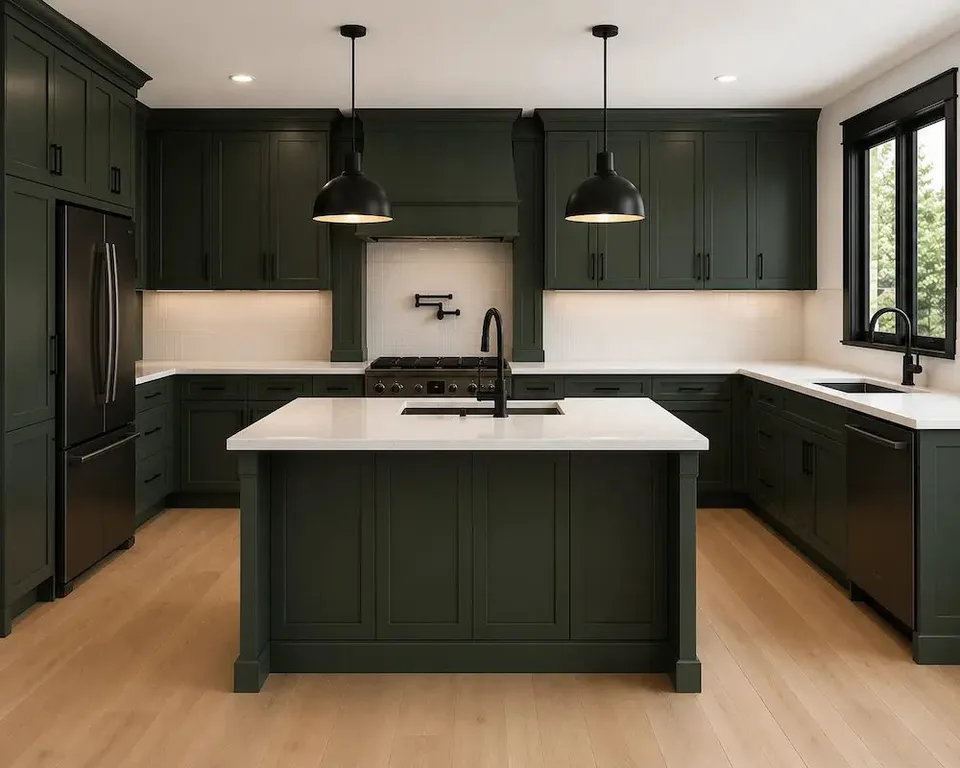
Where brass makes dark green feel traditional, matte black makes it feel current. This Riverview kitchen commits all the way, with black dome pendants, a black faucet and pot filler, black pulls, black appliances, and black window frames set against deep green cabinetry on every wall and the island. White quartz and a plain white backsplash carve out the light, and the result is the crispest, most modern room in this guide. It also proves the rule, repeat the black at least three times so the hardware reads as a decision, not an accident.
Olive and Two Tone Green Kitchens
7. Olive Green With Natural Wood Warmth
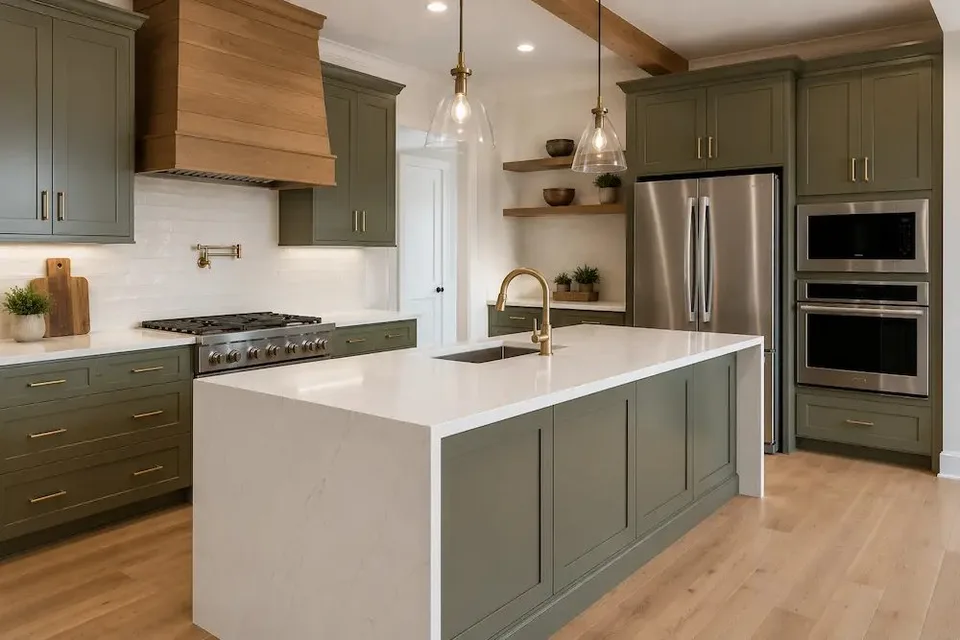
Olive sits between sage and forest, with a yellow undertone that loves wood, and this Tarpon Springs kitchen leans all the way in. A shiplap style wood hood, exposed ceiling beams, and floating shelves surround the olive cabinetry, while a white quartz waterfall on the island keeps the room feeling fresh instead of heavy. It is the green that looks like it has always been there, which is exactly why it suits the older neighborhoods we cover in our guide to kitchen remodeling in Tarpon Springs. One more note on the richest greens before the next idea, emerald and hunter can overwhelm a full kitchen but they are perfect in a contained space, a coffee bar, a butler pantry, or a bank of glass front cabinets, where the small footprint lets you go bolder on both the color and the hardware.
8. Two Tone: Green Lowers, White Uppers
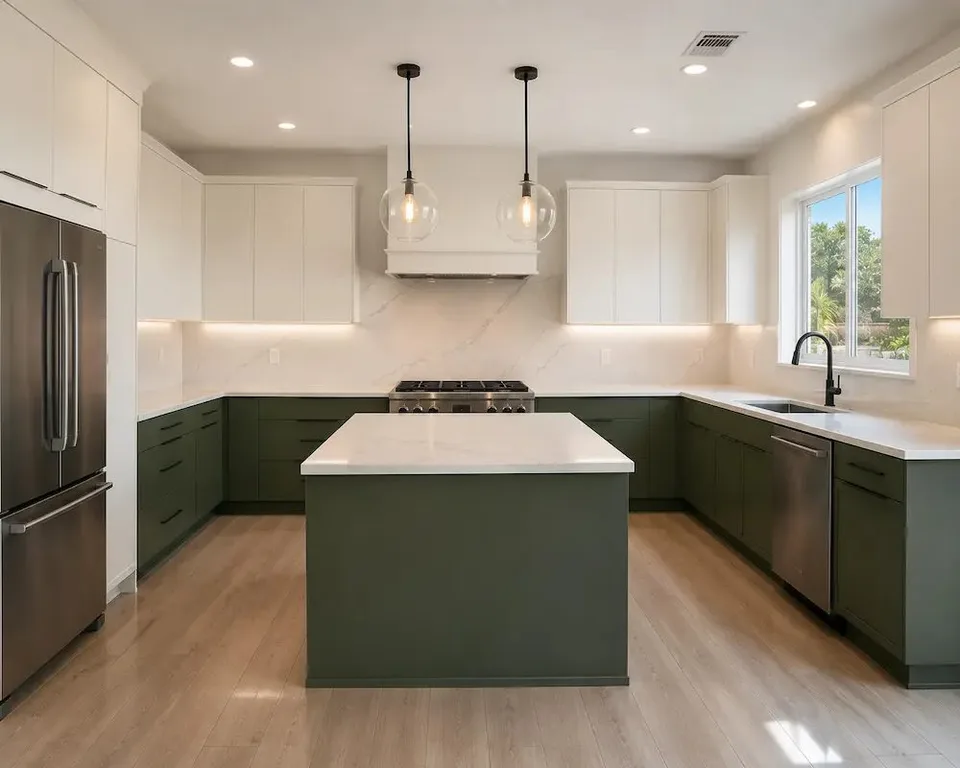
Green on the bottom, white on top grounds a room while keeping the sight lines bright, and this Siesta Key kitchen shows why it is the most forgiving way to run the color. The green lowers wrap the entire perimeter and the island base while white uppers, a white hood, and a marble look slab backsplash do the reflecting, so the kitchen stays airy even with color on every base cabinet. Black pulls, a black faucet, and black stemmed globe pendants sharpen the palette without stealing from it. If you like this balance, our white kitchen ideas post shows the other half of the equation done ten different ways.
Designer Picks: Green Paint Colors for Florida Light
Florida light is stronger and cooler than the light in the magazine photos where most people first fall for a green. A color that looks moody in a New England kitchen can turn minty here. These are the greens our design team reaches for again and again because they hold their character under Tampa Bay sun.
| Paint color | Brand | Green family | Where it works best |
|---|---|---|---|
| October Mist 1495 | Benjamin Moore | Silvery sage | Whole kitchens in bright, open rooms |
| Clary Sage SW 6178 | Sherwin Williams | Classic sage | Full perimeters with brass hardware |
| Evergreen Fog SW 9130 | Sherwin Williams | Gray green | Coastal palettes next to white quartz |
| Pewter Green SW 6208 | Sherwin Williams | Deep gray green | Islands and lower cabinets |
| Backwoods 469 | Benjamin Moore | Forest green | Statement kitchens with strong natural light |
| Ripe Olive SW 6209 | Sherwin Williams | Dark olive | Butler pantries, coffee bars, accent runs |
One rule of thumb carries across all six: check the undertone against your fixed finishes first. Yellow leaning greens like olive want warm floors and warm metals. Blue leaning greens like Evergreen Fog want cooler stone and crisper whites. The green itself is rarely the mistake. The clash with an existing floor tile usually is.
What Goes With Green Kitchen Cabinets
Countertops
White and warm white quartz are the default for a reason, they give the green a clean stage and keep the room bright. Quartz with soft gray veining adds movement without competing. Butcher block belongs with sage and olive, where the wood and the green share warm undertones. The one pairing to test carefully is heavy dramatic veining against a dark green, which can fight for attention in a smaller room.
Hardware
Brass and champagne bronze are the classic partners, warming every green from sage to hunter. Matte black modernizes dark greens and adds definition to light ones. Brushed nickel is the quiet option and suits the cooler, grayer sages. Whatever you choose, carry the finish through to the faucet and lighting so the room reads as one decision.
Backsplash and Walls
With a color this present on the cabinets, the backsplash should support, not compete. White subway tile, handmade look zellige style tile in cream, or a quiet quartz slab run up the wall all work. For paint, warm whites keep the room cohesive, think along the lines of Sherwin Williams Alabaster or Benjamin Moore White Dove rather than a stark bright white, which can make the green feel like it was dropped into someone else’s kitchen.
Six Green Cabinet Mistakes to Avoid
- Choosing from a tiny swatch. Greens shift more than almost any other color family as the light changes. Judge your finalist on the largest sample you can get, in your kitchen, at morning and at night.
- Ignoring undertones against your fixed finishes. Your floor tile, your stone, and your appliances are staying. A yellow leaning olive against a cool gray porcelain floor will look off every single day, and no hardware swap fixes it.
- Going dark in a light starved room. Forest green in a kitchen with one small window turns to near black by late afternoon. If the room lacks natural light, keep dark green to the island or the lowers and let white uppers carry the brightness.
- Stacking competing colors. A green kitchen already has a point of view. Add a multicolor mosaic backsplash or a bold wall color on top of it and the room stops feeling designed and starts feeling busy.
- Settling for a site painted finish. Brushed or rolled paint on cabinet doors chips at the edges and swells in Florida humidity. A factory applied finish is harder, smoother, and the difference shows within the first year of real use.
- Forgetting resale is about restraint. Green sells well when the rest of the kitchen stays classic. Keep the counters light, the layout functional, and the color becomes a selling feature instead of a repaint line item on a buyer’s inspection notes.
Want to see how a green would look in your kitchen before you commit? Call (813) 379 2116 or schedule your free in home consultation and we will start with your space, your light, and your budget.
How CMK Builds a Green Kitchen
Color is the fun part, but a kitchen this considered gets built on process. It starts with a free in home consultation where we scope the project in your actual space. Once you sign, you work one on one with an accredited designer, and selections happen in our 4,000 sq ft Design Studio in Tampa, where you can put green door samples, quartz, tile, and hardware side by side under real light before anything is ordered. Clients on the south end of our service area have the same experience at our Sarasota showroom on Clark Road.
The build side matters just as much. Cabinet projects almost always touch plumbing and electrical, and this is where CMK is built differently. Our plumbing is performed in house by our own team under our state certified plumbing license, and electrical work is coordinated through one licensed process, so sink relocations, disposals, and under cabinet lighting all run through a single accountable contract. That structure is a big part of why the kitchens above got finished on plan, backed by 21 years in Tampa Bay, more than 7,136 completed projects, and six straight years as a Tampa Bay Times Best of the Best winner. If you are earlier in your research, our kitchen remodeling page is the best place to see the full scope of what a project includes.
FAQ
Are green kitchen cabinets going out of style?
No, green has moved past the trend stage and settled in as a classic, the way navy did a decade ago. It has now held strong demand for several years running, paint brands keep building their color of the year picks around it, and it photographs well in both traditional and modern kitchens, which is the real test of staying power. The greens that age best are the ones grounded in nature, sage, olive, and forest, paired with classic counters and hardware. The versions that date themselves are usually the result of a trendy pairing, not the green itself. If you keep the rest of the kitchen timeless, a green kitchen will still look intentional in ten years.
Do green kitchen cabinets hurt resale value?
Not when the rest of the kitchen stays classic, and a well executed green kitchen often photographs better in a listing than one more white one. Buyers respond to color that looks intentional, which means light countertops, a functional layout, and hardware that matches across the room. Where green costs sellers money is when it arrives bundled with dated pairings or a site painted finish that shows wear at the edges. If resale sits at the top of your list, the safest structures are the two tone approach or a green island under a white perimeter, since either can be refinished later without touching the rest of the kitchen. Sage and the gray greens are the most buyer friendly families, while deep forest is more of a personal statement.
What is the most popular green for kitchen cabinets right now?
Sage green is the most requested by a wide margin, because it behaves like a neutral and works in almost any home. Within our own projects, sage leads for full kitchens while deeper forest and hunter greens lead for islands and lower cabinets. Olive has been climbing as homeowners lean into warmer, earthier palettes, and the gray greens like Evergreen Fog remain the favorite for coastal style homes near the water. If you are torn, sage on the perimeter with a deeper green island gives you both answers in one kitchen.
What countertops look best with green cabinets?
White and warm white quartz are the most reliable pairing, because they brighten the room and let the cabinet color lead. Quartz with soft gray veining adds interest without competing, and butcher block is a natural partner for sage and olive since they share warm undertones. If you love dramatic, heavily veined stone, test it against your specific green at full size first, because bold veining next to a dark green can make a smaller kitchen feel busy. As a rule, the stronger the cabinet color, the calmer the countertop should be.
What color hardware goes with green kitchen cabinets?
Brass and champagne bronze are the classic choices and they flatter every green in this guide, which is why you see them in most of the kitchens above. Matte black gives dark greens a sharper, more modern edge, and brushed nickel suits the cooler, grayer sages if you prefer a quieter look. The finish matters less than the consistency, so repeat your choice across the pulls, the faucet, and the lighting. When the metals match, the whole room reads as one deliberate design instead of a collection of parts.
Do dark green cabinets make a kitchen look smaller?
They can, but only when the room does not have the light to support them. In a kitchen with tall windows, sliders, or an open floor plan, dark green adds depth rather than shrinking the space, and Florida homes have an advantage here because our natural light is so strong. In a kitchen with limited windows, the safer play is dark green on the island or the lower cabinets with white uppers doing the reflecting. That two tone approach keeps the drama of the color while the room stays bright, and it is the layout we recommend most often for average sized Tampa Bay kitchens.
Should green cabinets be a painted finish or stained wood?
For a true green, you want a factory applied painted finish. Paint gives you exact color control across every door and panel, and a factory catalyzed finish is baked on under controlled conditions, so it resists chipping, moisture, and daily wear far better than anything brushed on in a garage. Stains show wood grain beautifully but they limit you to muted, earthy greens and the color varies with the wood underneath. The middle ground some homeowners love is a painted green kitchen with one stained wood element, like an island top or floating shelves, so you get color accuracy and natural warmth in the same room.
What wall colors go with green kitchen cabinets?
Warm whites are the safest and most flattering choice, colors in the family of Sherwin Williams Alabaster or Benjamin Moore White Dove. They keep the room cohesive and let the cabinets be the feature. Stark, cool whites can make a warm green feel disconnected, and adding a second strong color to the walls usually makes the kitchen feel smaller and busier. If you want more depth, pull a pale version of your cabinet green or a soft cream onto the walls and keep the trim white. The goal is for the walls to frame the green, not to compete with it.
What color floors go with green kitchen cabinets?
Light and mid tone wood floors are the most reliable partners, and white oak style warm neutrals sit under nearly every kitchen in this guide for a reason. They add warmth without competing, and they keep the darker greens from making a room feel heavy. Cooler gray floors can work with the gray leaning sages like Evergreen Fog but tend to fight yellow leaning olives. Large format porcelain in a soft warm white is a strong option for Florida homes that want tile underfoot. The one combination to avoid is a strongly red or orange toned floor beneath a cool green, because the undertones argue with each other every time the light changes.
Are green cabinets harder to keep clean?
No, the color does not change how you clean a cabinet, a soft cloth and mild soap works on any factory finish. What changes is what shows between cleanings. Mid tone greens like sage and olive are among the most forgiving colors in a kitchen, hiding dust, fingerprints, and water spots better than white or very dark cabinets. Deep greens behave like any dark color, so smudges around the hardware appear sooner, especially in flatter sheens. The bigger factor is finish quality, since a factory applied catalyzed finish wipes clean and resists staining in a way a site painted door never will, which is one more reason we steer clients toward factory finished green rather than repainting on site.