When planning a kitchen remodel, bathroom renovation, or whole-home update in Tampa Bay, you will likely encounter the term state-certified general contractor. While it sounds official, many homeowners do not fully understand the rigorous standards behind this designation or how it differs from a registered contractor. Hiring the right professional is the most critical decision you will make for your home improvement project. In Florida, a CGC represents the highest level of licensing and competency recognized by the Department of Business and Professional Regulation (DBPR).
In this guide, we will explain exactly what a state-certified general contractor means in Florida, the strict requirements to earn this license, and why choosing a certified professional like CMK Construction protects your investment and ensures a trusted, process-driven remodeling experience.
Quick Answer: In Florida, a state-certified general contractor is licensed through the DBPR and can work statewide. For Tampa Bay homeowners, hiring a certified contractor helps protect your remodel because the contractor must meet state licensing, experience, insurance, financial responsibility, and code-compliance requirements.
Why This Matters Before You Hire a Remodeler
Your kitchen or bathroom remodel is not a single trade job. It may involve plumbing, electrical, structural modifications, waterproofing, and multiple rounds of permitting and inspections. The wrong contractor can create code problems, insurance coverage gaps, failed inspections, and expensive repairs that cost more than the original project.
A properly licensed contractor gives you, the homeowner, more accountability. Their license is on the line with every permit they pull. Their insurance and bonding protect you if something goes wrong. And the state maintains a public record of their credentials, disciplinary history, and business standing that you can verify before signing a contract.
This is why understanding what “state-certified general contractor” actually means in Florida is worth a few minutes of your time before you commit to any remodeling company.
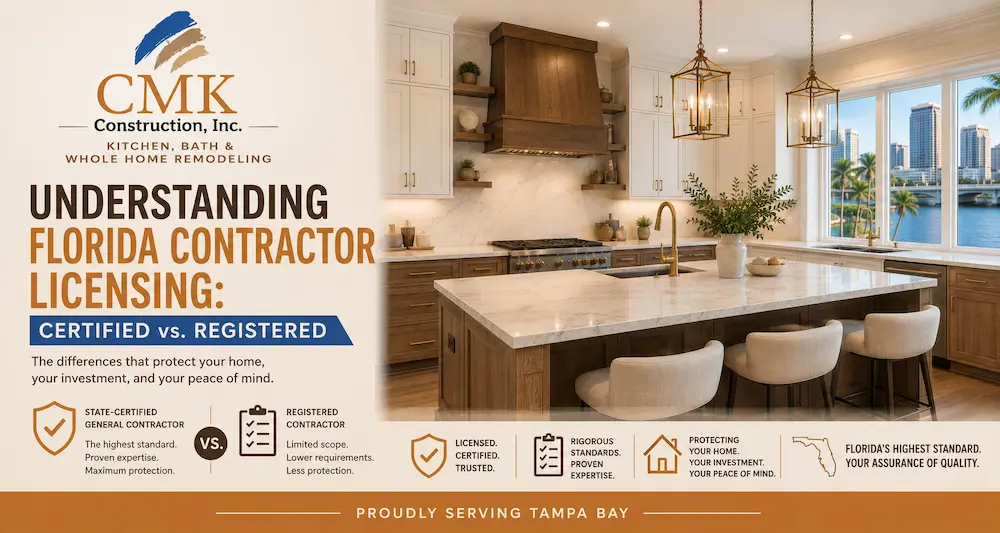
Understanding Florida Contractor Licensing: Certified vs. Registered
The State of Florida issues two primary categories of construction licenses: certified and registered. Understanding the distinction is essential for any homeowner embarking on a significant renovation.
A registered contractor has met the competency requirements for a specific local jurisdiction, such as a single county or city. They are legally restricted to performing work only within that geographic area. While they are licensed locally, they have not necessarily passed the comprehensive state-level examinations.
Conversely, a certified contractor possesses a certificate of competency issued directly by the DBPR. This certification allows them to contract in any jurisdiction throughout the entire state without needing to fulfill additional local competency requirements [1]. Certified contractors are identified by a license number beginning with the letter “C” (e.g., CGC for Certified General Contractor).
A CGC holds an “unlimited” license. This means their services are unlimited regarding the type of work they can perform, encompassing both commercial buildings of any height and residential structures [2]. They are qualified to manage the most complex and demanding construction projects in the state.
| Feature | Certified General Contractor (CGC) | Registered Contractor |
| Service Area | Statewide (Any jurisdiction in Florida) | Limited to specific local city/county |
| Scope of Work | Unlimited (Commercial and Residential) | Varies by local registration |
| State Examinations | Required (Trade, Business, Project Management) | Not required by the state |
| License Prefix | Starts with “C” (e.g., CGC) | Starts with “R” (e.g., RGC) |
The Rigorous Path to Becoming a Certified General Contractor
Earning a CGC license in Florida is a demanding process designed to protect consumers. The state enforces strict standards for experience, knowledge, and financial stability that go well beyond what most homeowners realize.
Extensive Experience Requirements
Applicants cannot simply take a test to become a certified general contractor. The DBPR requires a minimum of four years of proven field experience working under a licensed contractor. Crucially, at least one of those years must be in a supervisory capacity, and another year must involve new construction of structures no less than four stories in height [3]. They must also demonstrate hands-on experience in complex structural categories, such as elevated slabs, steel erection, and masonry walls.
Challenging State Examinations
The examination process is demanding. Candidates must pass comprehensive exams covering Trade Knowledge, Project Management, and Contract Administration, as well as a 6.5-hour Business and Finance exam consisting of 125 questions on accounting principles, Florida-specific construction statutes, and financial management [3]. The exams are open-book, but the volume of material and strict time constraints mean that only well-prepared professionals with deep industry knowledge pass on their first attempt.
Financial Responsibility and Stability
Florida law mandates that all certified contractors establish financial responsibility and stability. This includes submitting personal and business credit reports, maintaining a FICO credit score of 660 or higher (or completing a 14-hour financial responsibility course), and proving there are no unsatisfied liens or judgments against them [4]. This ensures that the contractor managing your project has the financial health to see it through to completion.
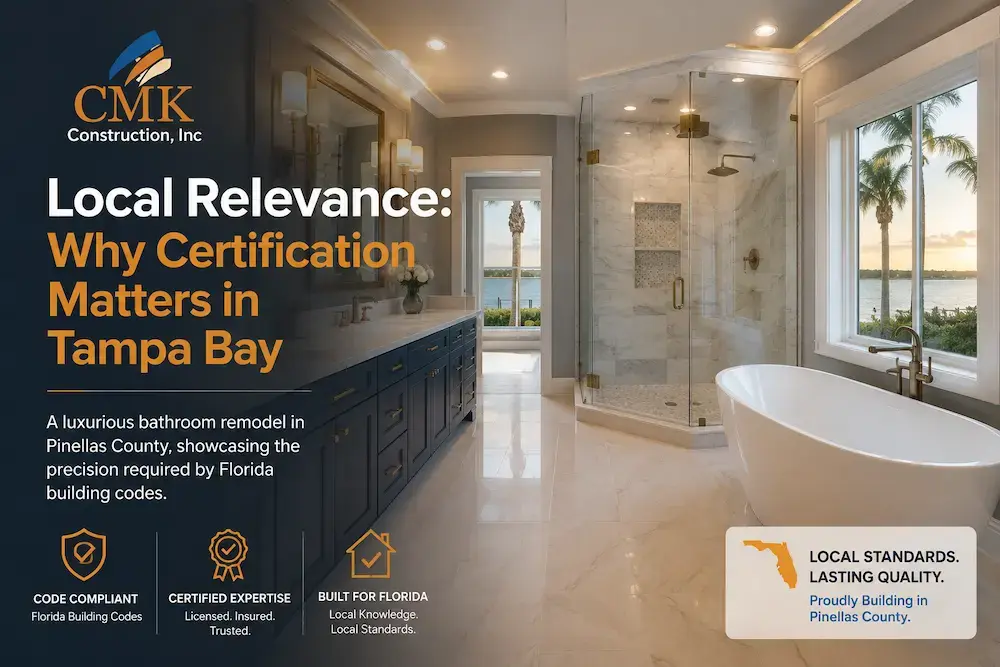
Local Relevance: Why Certification Matters in Tampa Bay
The Tampa Bay area presents unique challenges for home remodeling. Our high humidity, intense storm seasons, and specific coastal building codes require a deep understanding of structural integrity and moisture management.
A certified GC is rigorously tested on the Florida Building Code, which is one of the strictest in the nation due to our climate. When renovating a home in Hillsborough, Pinellas, or Pasco counties, the contractor you hire must understand how to properly evaluate roof-to-wall connections, manage complex HVAC requirements, and ensure all installations can withstand local environmental stressors.
For instance, when updating a bathroom near wet areas, specific tempered glass requirements must be met to comply with safety codes. Furthermore, managing the permitting process across different Tampa Bay municipalities requires a high level of organizational competence. A certified contractor regularly manages permits and understands the nuances of local inspections, ensuring your project moves forward without costly delays.
The CMK Differentiator: Comprehensive In-House Licensing
At CMK Construction, we are in the happy customer business. We believe that delivering a trusted, process-driven remodeling experience requires more than just a single license. We hold multiple state certifications, setting a standard that few competitors can match.
CMK Construction is a State-Certified General Contractor (License #CGC1516665). We have been serving the Tampa Bay area since 2004, completing over 7,000 projects with a focus on quality, process, and experience.
Our commitment to accountability extends further. Unlike many remodeling companies that rely entirely on unvetted subcontractors for critical systems, CMK also holds a State-Certified Plumbing Contractor license (CFC 1430533), a Certified Roofing Contractor license (CCC 1336554), and a Registered Electrical Contractor license (ER 13016498).
By utilizing our in-house licensed plumbers and electricians, we maintain strict quality control over the most sensitive aspects of your kitchen or bathroom remodel. This comprehensive licensing approach ensures that every wire pulled and every pipe fitted meets our exacting standards and complies fully with Florida law. When paired with our use of the Schluter waterproofing system, which is installed behind every project to prevent failures, you can trust that your renovation is built to last.
Common Mistakes to Avoid When Hiring a Contractor
Choosing the wrong contractor can lead to significant financial loss and emotional stress. Avoid these common pitfalls when planning your remodel:
- Hiring an Unlicensed Individual: This is the most dangerous mistake a homeowner can make. Contracting without a license is a first-degree misdemeanor in Florida [5]. In many cases, contracts entered into by unlicensed contractors may be unenforceable by the unlicensed contractor under Florida law, which leaves you with limited legal recourse if the work is abandoned or performed poorly.
- Failing to Verify Insurance: A reputable certified contractor will carry substantial general liability insurance and workers’ compensation coverage. This protects you from liability if an accident occurs on your property.
- Ignoring the Permitting Process: If a contractor suggests that you, as the homeowner, should pull the permit as an “owner-builder” to save money, this is a major red flag. Licensed contractors are required to pull their own permits and assume responsibility for the work.
- Assuming Any Contractor Can Work in Your Condo: In Florida, condominiums are classified as commercial structures regardless of whether you live there full-time. Many contractors with only a residential license cannot legally perform work in a condo building. A Certified General Contractor holds an unlimited license that covers both residential and commercial structures, making them qualified to remodel your condo unit while meeting the building’s HOA and permitting requirements.
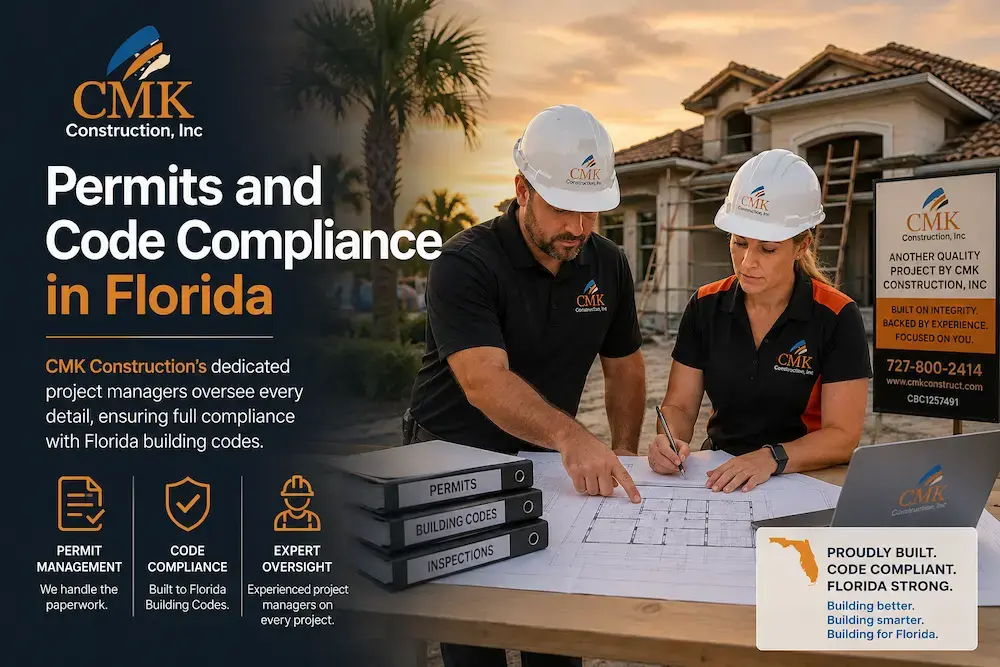
Permits and Code Compliance in Florida
Navigating the permitting process is a critical component of any significant home remodel. Permits are not merely bureaucratic red tape; they are essential safeguards designed to ensure that all construction meets the safety standards established by the Florida Building Code.
A certified general contractor handles the entire permitting process on your behalf. They prepare the necessary architectural drawings, submit the applications to the local building department, and coordinate all required inspections throughout the project lifecycle.
Attempting to bypass permits can result in severe consequences, including stop-work orders, hefty fines, and the requirement to tear out completed work for retroactive inspections. Furthermore, unpermitted work can complicate the future sale of your home and may void your homeowner’s insurance coverage in the event of a failure. By partnering with a certified professional, you guarantee that your project is fully compliant, safe, and legally documented.
Frequently Asked Questions
1. What does state-certified general contractor mean in Florida?
A state-certified general contractor (CGC) is a professional who has passed rigorous state examinations, proven extensive structural experience, and demonstrated financial stability. They hold a certificate of competency from the DBPR, allowing them to perform unlimited commercial and residential construction anywhere in the State of Florida.
2. How can I verify if a contractor is state-certified?
You can verify a contractor’s license status by visiting the Florida DBPR website and using their online license search tool. Look for a license number beginning with “CGC” and ensure the status reads “Current, Active.”
3. What happens if I hire an unlicensed contractor in Florida?
Hiring an unlicensed contractor exposes you to significant risk. In many cases, contracts entered into by unlicensed contractors may be unenforceable by the unlicensed contractor under Florida law. If the contractor damages your property or abandons the job, you cannot access the Florida Homeowners’ Construction Recovery Fund. Additionally, you may be held liable for injuries that occur on your property.
4. Why is it important that CMK Construction has in-house plumbers and electricians?
Having in-house licensed tradesmen ensures higher quality control, better scheduling efficiency, and greater accountability. Instead of relying on external subcontractors whose availability and quality may vary, CMK’s dedicated team manages the critical plumbing and electrical systems under our direct supervision.
5. Does a certified contractor carry insurance?
Yes. To maintain their active license status, a certified general contractor in Florida must carry adequate general liability insurance and workers’ compensation coverage, protecting homeowners from liability in the event of property damage or workplace injuries.
Ready to Transform Your Home?
Understanding what a state-certified general contractor means in Florida is the first step toward a successful remodel. When you choose CMK Construction, you are partnering with a highly credentialed, award-winning team dedicated to delivering an exceptional experience from design to final walkthrough.
With our comprehensive licensing, in-house designers, and dedicated project managers, we handle every detail so you can enjoy the process of building your dream home.
Schedule Your Free Consultation Today or call us at (813) 379-2116.