Quick answer: A whole-home flooring replacement usually comes down to 6 options: solid hardwood, engineered wood, laminate, luxury vinyl plank, tile and carpet. The ideal blend hinges on the humidity levels in each space, the condition of the base beneath the current surface, and the desired lifespan of the installation. HomeGuide reports an average installed cost of $4 to $15 per square foot, which totals $8,000 to $30,000 for a 2,000 square foot area. In addition to the flooring material, HomeGuide notes that taking out the previous surface, subfloor repair, underlayment, trim and stairs are additional expenses.
Renovating individual rooms differs from executing a whole-house project. The latter follows a single timeline: furniture is moved once, old surfaces are stripped simultaneously, and subfloor issues appear together. One material or a curated collection of surfaces extends through all spaces. This approach also demands unified decisions regarding moisture, legacy materials, and sequencing, which a localized renovation might avoid. This guide details the scope of work, compares the primary choices, explains cost factors, and outlines pre-installation checks. All data points originate from a trade association, a government agency or a published cost guide in the Sources list, verified in September 2026.
What Does a Whole-Home Flooring Replacement Include?
Pricing for a whole house extends beyond the cost of the new floor. Estimates typically encompass some or all of the following tasks:
- Moving furniture. Certain contractors handle this; if not, HomeGuide advises budgeting $25 to $75 per room extra if the furniture is not moved before installation.
- Removing the old floor. HomeGuide notes carpet removal costs $0.70 to $1.60 per square foot, while tile removal ranges from $2 to $7 per square foot.
- Checking and repairing the subfloor. Fixes or a full swap of the subfloor might be required to ensure the new surface sits on a solid, level surface; HomeGuide estimates subfloor replacement at $2.20 to $4.75 per square foot for materials and labor.
- Underlayment. According to HomeGuide, underlayment runs $0.50 to $3.50 per square foot installed and is generally required beneath linoleum, laminate, vinyl and hardwood.
- Trim, transitions and stairs. HomeGuide lists interior trim at $350 to $1,200 per room and carpeting a staircase at $150 to $600 on average, or $10 to $45 per step.
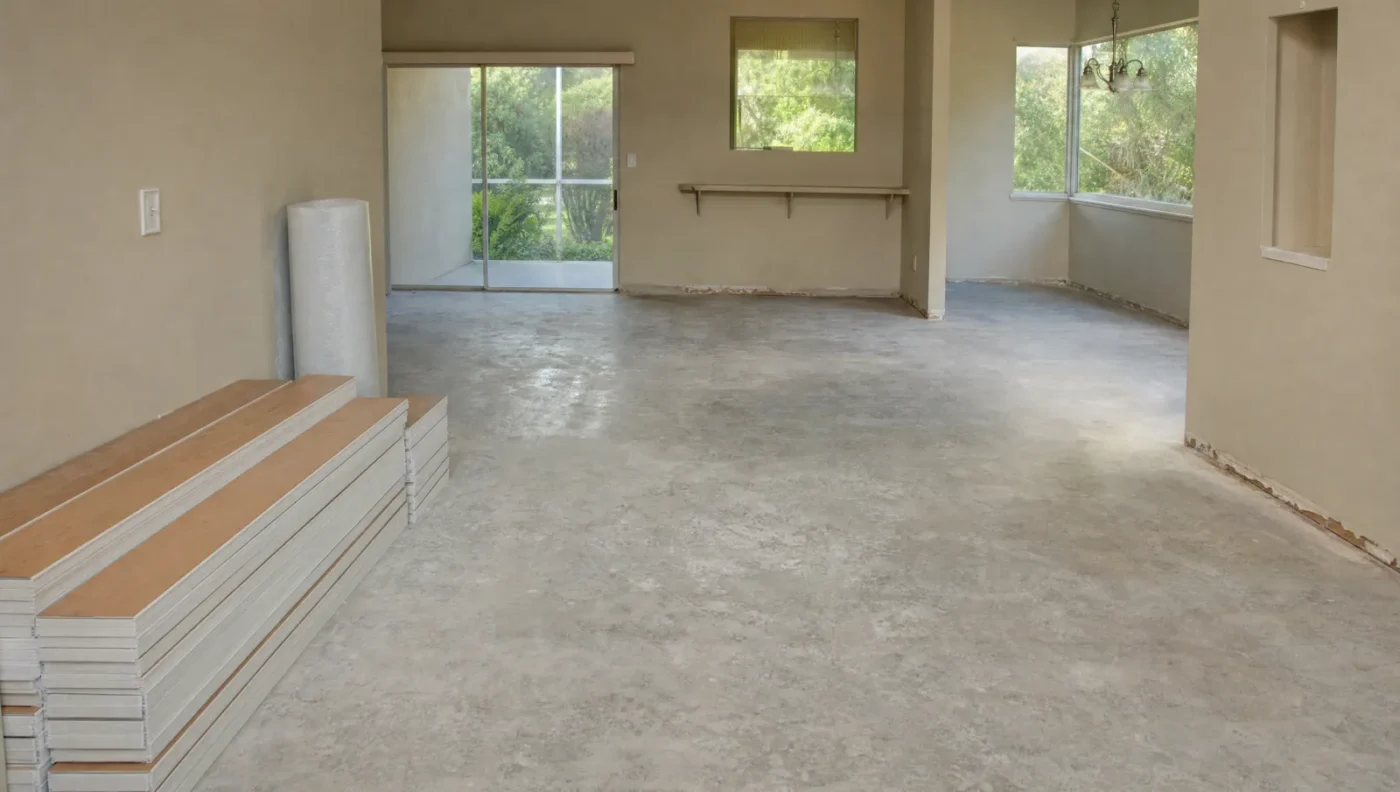
The position of the flooring within a larger project is also significant. For wood floors, the NWFA Installation Guidelines state that the wet trades, such as drywall, texturing and primer coats of paint, should be finished before the flooring arrives. The overall order of operations is detailed in how to plan a whole-home renovation.
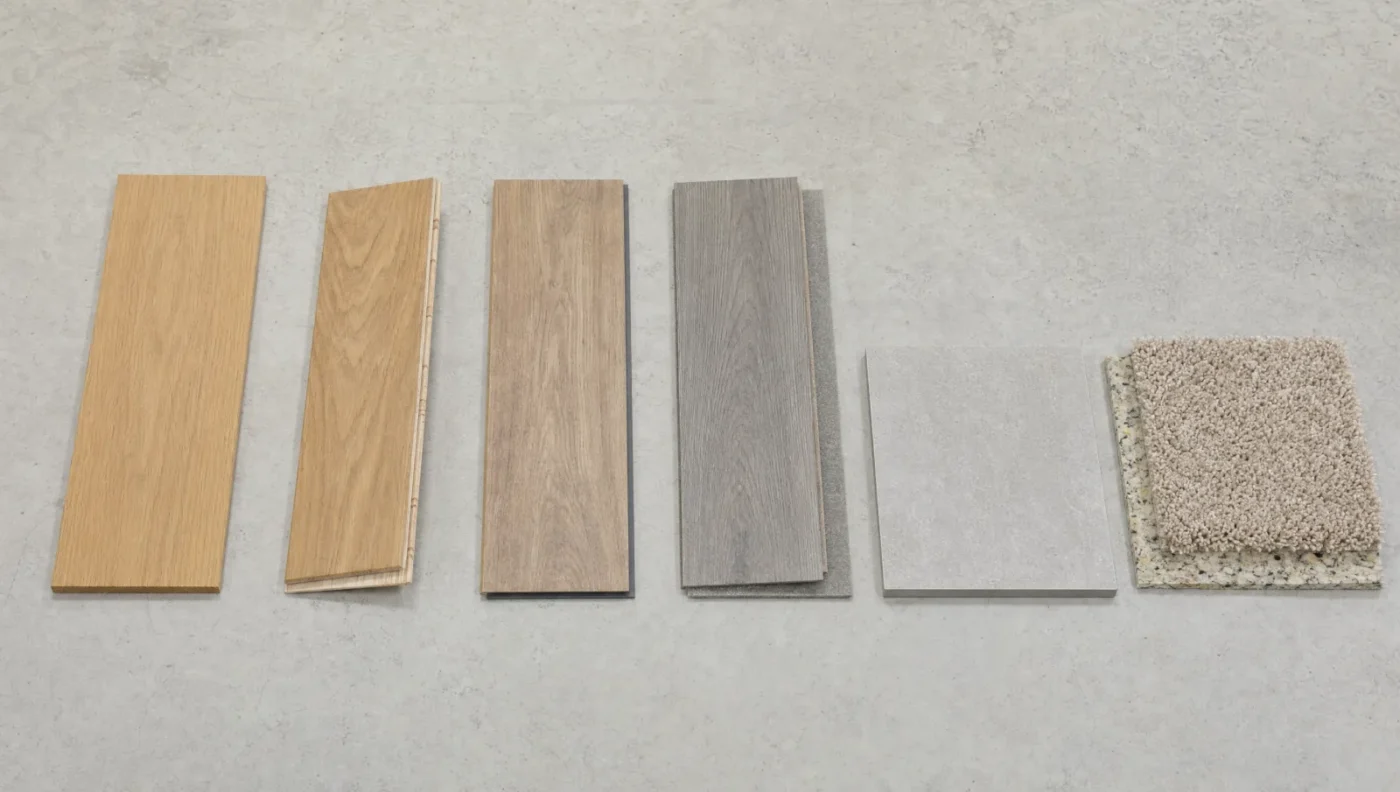
Comparison Table: Whole-Home Flooring Options
| Option | What it is | Key point | Installed cost per sq ft (HomeGuide) |
|---|---|---|---|
| Solid hardwood |
One piece of wood from top to bottom | Can be sanded and refinished many times; for rooms on or above ground | $11 to $25 |
| Engineered wood |
Real wood in multiple layers, with a high-quality wood top layer | Expands and contracts less than solid wood, so NWFA calls it ideal for basements; can be refinished fewer times | $7 to $20 |
| Laminate | Wear layer, decorative layer, wood-based core and backing | Not for areas with excessive moisture, such as bathrooms, unless the manufacturer specifies it as waterproof | $4 to $14 |
| Luxury vinyl plank |
Flexible LVT, or rigid core with a rigid polymeric core and decorative top | Thicker and more durable than standard vinyl | $4 to $16 |
| Porcelain and ceramic tile |
Porcelain is ceramic tile with water absorption of 0.5% or less | Ceramic and porcelain are the popular budget choices within tile | $10 to $50 |
| Carpet | Carpet, with padding priced separately at $0.75 to $1.75 per sq ft | Comfortable under foot and a common choice for bedrooms | $2 to $8 |
How Do the Main Flooring Options Differ?
The table gives the short version. The details that determine which option fits a room are presented here.
Solid hardwood
Solid wood flooring consists of a single wood piece from top to bottom, making it suitable for any room on or above ground level. The National Wood Flooring Association notes that a key benefit is the ability to have the surface sanded and refinished many times. HomeGuide estimates the cost at $11 to $25 per square foot installed, varying by species and thickness, and indicates that the material may endure for generations if maintained correctly. This option demands the most preparation among those listed. The NWFA Installation Guidelines require the home to be kept at normal living temperature and humidity for a minimum of five days prior to installation, alongside testing the subfloor for moisture content.
Engineered wood
Engineered wood is also genuine timber, constructed in multiple layers featuring a high-quality wood top layer. NWFA explains that it expands and contracts less than solid wood, making it ideal for basement installations, and confirms it can be sanded and refinished, though the number of times is lower than for solid wood. HomeGuide lists the price at $7 to $20 per square foot installed. Florida homes rarely have basements, but that same stability is why engineered wood is the steadier choice when wood goes over a concrete slab, which is what most Tampa Bay homes sit on. Our LVP vs. tile vs. hardwood guide for Florida covers slab moisture testing in more detail.
Laminate
The North American Laminate Flooring Association describes this layered product as having a protective wear layer, a decorative layer, a wood-based core, and a backing layer. NALFA indicates that it fits nearly any room, excluding spaces with excessive moisture like bathrooms and saunas, unless the maker labels it as waterproof. HomeGuide lists the installation cost at $4 to $14 per square foot installed.
Luxury vinyl plank
The Resilient Floor Covering Institute identifies luxury vinyl tile as flexible resilient flooring produced in tile or plank shapes. It also categorizes a newer rigid core type as modular flooring that includes a rigid polymeric core, a decorative top surface, and an optional pre-attached underlayment. HomeGuide states that luxury vinyl plank costs $4 to $16 per square foot installed and describes the material as possessing greater thickness and durability compared to standard vinyl.
Tile
ANSI A137.1 defines porcelain as a ceramic tile where water absorption stays at 0.5% or below. HomeGuide identifies porcelain tile as the most common bathroom flooring choice (the differences are covered in porcelain vs ceramic tile). HomeGuide prices tile floors between $10 and $50 per square foot installed, with costs varying based on the specific tile, regional labor costs, and project complexity. For wet rooms specifically, see these bathroom flooring tips.
Carpet
HomeGuide prices carpet between $2 and $8 per square foot, a figure that covers both materials and labor, while describing the material as comfortable underfoot and a popular option for bedrooms, finished basements, and offices. The source adds that some homeowners opt for hard flooring in all rooms of the house rather than carpet.
What Drives the Cost of Replacing Flooring in a Whole House?
The base price is determined by the square footage and the material set, while the remainder of the total depends on the state of the existing surfaces. HomeGuide provides data on the range for whole-house sizes:
| Cost item | HomeGuide figure |
|---|---|
| 1,500 sq-ft home |
$6,000 to $22,500 installed |
| 2,000 sq-ft home |
$8,000 to $30,000 installed |
| Labor | $2 to $8 per sq ft on average |
| Subfloor replacement |
$2.20 to $4.75 per sq ft |
| Asbestos removal |
$4 to $15 per sq ft |
| Hardwood refinishing |
$2 to $8 per sq ft |
These figures lead to two conclusions. First, the material choice can alter the final cost by a multiple, making it prudent to get quotes for two or three options for the same floor plan. Second, completing the home in a single job prevents paying multiple minimums: HomeGuide notes that many contractors enforce a $200 to $500+ minimum project fee, and that the installation cost per square foot may be higher on small projects for that reason. If certain rooms already feature sound hardwood, refinishing them at $2 to $8 per square foot serves as an alternative to replacing every floor.
When flooring is part of a larger renovation, it’s one line in a bigger budget. Our guide to whole-home renovation cost per square foot in Florida shows where it fits.
What Should You Check Before the Old Floors Come Up?
Several inspections determine if the removal process is straightforward or requires expert help.
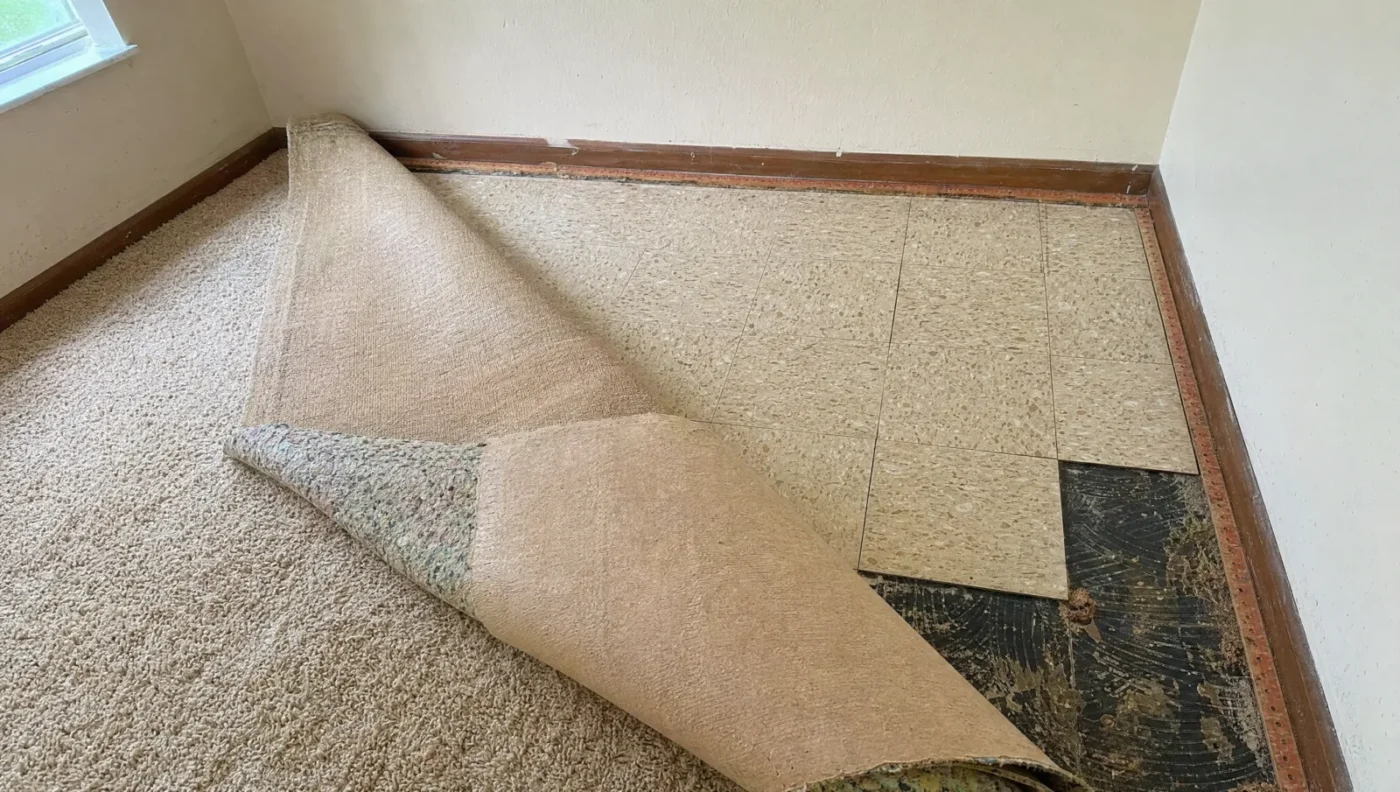
- Asbestos in older flooring. EPA lists vinyl floor tiles, the backing on vinyl sheet flooring, and adhesives as locations where asbestos may be found. The agency states that visual inspection is generally insufficient to identify the material, advises consulting a trained and accredited asbestos professional before remodeling, and notes that self-sampling is not recommended.
- Lead paint on trim in pre-1978 homes. EPA reports that roughly three-quarters of U.S. homes built before 1978 still contain some lead-based paint. Under the RRP Rule, individuals paid to disturb painted surfaces in those homes must be certified. Removing painted baseboards to install new flooring disturbs painted surfaces. Both checks matter in older neighborhoods like Seminole Heights and South Tampa, where many homes were built long before 1978.
- Moisture in the subfloor or slab. Before wood is installed, NWFA guidelines require testing the subfloor for moisture content. When laying laminate over an above-grade slab, NALFA states the concrete must be fully cured, at least 90 days old, with a 6-mil vapor barrier and underlayment padding. Because most Tampa Bay homes sit on a concrete slab, this check applies to nearly every whole-home job here.
- Formaldehyde labeling on wood-based products. According to the EPA, composite wood products, which include hardwood plywood, medium-density fiberboard, particleboard, and finished goods containing them, must be labeled TSCA Title VI compliant. When dealing with any wood-based core, checking for that label serves as a rapid verification method.
Can the New Floor Go Over the Old One?
Sometimes, and it depends on both floors. NALFA’s subfloor guide states that laminate can be laid on flat, smooth ceramic tile after inspecting for cracked or loose pieces, on level sheet vinyl that is in good condition and has padding, and on stable, flat hardwood. The document also notes that current laminate or bamboo does not serve as a suitable base for new laminate, and requires the removal of all carpet, padding and staples. Regarding flooring that contains asbestos, EPA recommends placing a new floor covering over the material when feasible, while avoiding sanding or attempts to level the substance or its backing. Retaining the previous surface increases the floor height, necessitating a review of doors, transitions and appliance clearances prior to selecting this approach.
So Which Flooring Should You Choose?
Most whole-home projects feature a single primary flooring alongside a distinct selection for wet rooms. A straightforward method for making that choice:
- Bathrooms and other wet areas: porcelain tile, given its 0.5% or lower water absorption; laminate only if the maker designates it as waterproof.
- A wood floor you want to refinish over decades: solid hardwood, which can be sanded and refinished many times.
- Real wood over a slab or where movement is a concern: engineered wood, which NWFA calls ideal for basements.
- A wood or stone look at a lower installed cost: laminate or luxury vinyl plank, both starting at $4 per square foot installed in HomeGuide’s ranges.
- Bedrooms where comfort comes first: carpet, at $2 to $8 per square foot installed.
Where CMK Construction Fits
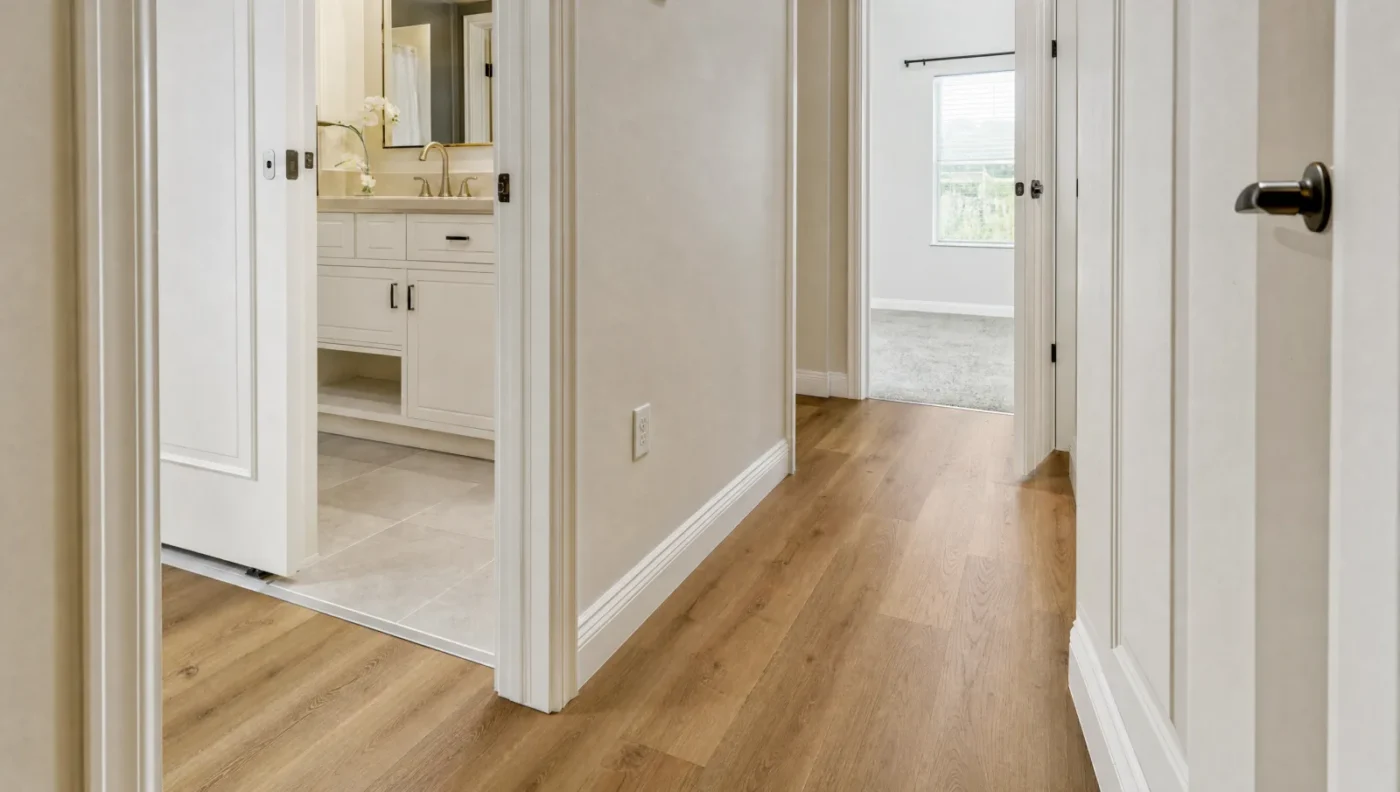
CMK Construction handles flooring as part of its remodels, including heated tile floors in bathroom remodels. For whole-condo remodels, a single team coordinates the kitchen, baths, flooring, and finishes. During condo projects, CMK builds hard-surface floors to meet association sound ratings (STC and IIC), which in practice means a rated acoustic underlayment, as on our Bradenton condo remodels. Before anything is ordered, CMK measures the space and verifies every structural detail. The firm also secures required permits, appoints a dedicated project manager, and backs its installed workmanship and materials with a one-year Peace of Mind Warranty. For flooring as part of a larger project, see our whole-home remodeling services.
Schedule a free consultation or call (813) 379-2116.
Related reading:
- In What Order Should You Renovate a House? (2026)
- How Much Does a Whole-Home Renovation Cost in Tampa Bay?
Whole-home flooring FAQ
Is it cheaper to replace flooring in the whole house at once?
Often, yes, per square foot. HomeGuide reports that numerous contractors impose a $200 to $500+ minimum project fee, and the installation cost per square foot might rise on smaller jobs. Executing a single whole-house project prevents you from incurring that minimum charge multiple times.
How long does a whole-home flooring replacement take?
It depends on the size of the house and the prep. HomeGuide estimates that a standard flooring installation takes 1 to 3 days, while noting that stripping out old materials and dealing with unforeseen fixes can extend the schedule. In the case of wood, NWFA guidelines also require the residence to remain at normal living conditions for at least five days prior to installation.
Should new flooring go in before or after painting?
After the wet work, for wood floors. The NWFA Installation Guidelines state that wet trades, including drywall, texturing and primer coats of paint, should be complete before wood flooring is delivered.
Can laminate go in a bathroom?
Only if the manufacturer specifies it as waterproof. NALFA notes that laminate should not be used in zones prone to excessive moisture, like bathrooms and saunas, unless the maker designates it as waterproof.
Should old vinyl flooring be tested for asbestos before it is removed?
Yes, when it could be an older product. EPA lists vinyl floor tiles, sheet vinyl backing and adhesives as places asbestos may be found, notes that visual inspection is typically insufficient, and advises hiring a trained and accredited professional to collect samples instead of attempting it personally.
Sources
- HomeGuide, How Much Does Flooring Installation Cost? (2026)
- Hardwood Floors magazine (NWFA), Who Should Determine When a Job Site is Ready for Wood Flooring Installation?
- National Wood Flooring Association, Types of Wood Floors
- North American Laminate Flooring Association, What is Laminate?
- North American Laminate Flooring Association, Laminate Flooring FAQs
- Resilient Floor Covering Institute, Resilient Flooring Types
- American National Standards Institute, The Eminence of Porcelain Tile
- U.S. EPA, Learn About Asbestos
- U.S. EPA, Protect Your Family from Exposures to Asbestos
- U.S. EPA, Lead Renovation, Repair and Painting Program
- U.S. EPA, Formaldehyde Emission Standards for Composite Wood Products
- CMK Construction, Kitchen and Bath Remodeling
- CMK Construction, Kitchen Remodeling
- CMK Construction, Condo Remodeling